New Academic Hub Planned for Drury University

SPRINGFIELD, MO – Drury University has announced Cooper Robertson as architect for its new Enterprise Center, a major academic building set to rise on the institution’s growing Springfield, MO, campus — and its first building project to be developed based on Cooper Robertson’s 2017 master plan.
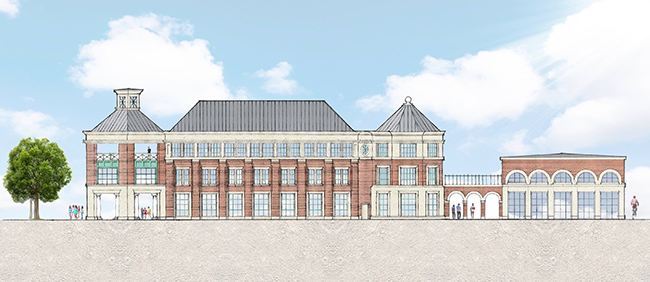
Drury University Academic Center

Rendering courtesy of Cooper Robertson

Designed in collaboration with Trivers Associates architects, the vision for the three-story, 54,772-square-foot Enterprise Center includes space for Drury's business and political science academic programs, as well as for high-tech student collaborative areas, facilities for guidance services and an executive conference center. According to Drury leaders, the project highlights an emphasis on entrepreneurship, innovation and interdisciplinary learning, and reflects the master plan’s recommendations for strategic moves that address the needs of today’s students in a rapidly changing world.

Other key features of the new building include an 11,000-square-foot Center for Executive Education attached by a colonnade to the main building. This conference center and flexible event space will be used extensively by the entire Drury campus as well as the greater Springfield community, reflecting the master plan’s goal of more tightly weaving Drury University into the fabric of its surrounding neighborhoods.

Groundbreaking is anticipated for spring 2020.

Featured

  • Indiana Wesleyan University Schedules Grand Opening for New Welcome Center

    Indiana Wesleyan University recently announced that it will soon open a new Welcome Center on its campus in Marion, Ind., according to a news release. The facility will serve as the home base for prospective students and their families to learn more about the university and student life there. A ribbon-cutting ceremony is scheduled for February 19.

  • Different Starting Points, Same End Goal

    Higher education campuses can enhance student experience by implementing mobile credentials to streamline building access, on-campus payments, and access to other amenities. This enables students to connect to their campuses through the technology they use most: their mobile devices.

  • Abstract tech network data connections with orange, blue glowing dots, lines

    3 Trends for Higher Education to Stay Ahead of in 2026

    As universities enter the new year, the question is no longer whether digital transformation is necessary, but how quickly institutions can convert technological potential into strategic advantage.

  • Spaces4Learning Trends & Predictions for Educational Facilities in 2026: Part II

    As education leaders look toward 2026, the design of K–12 and higher education facilities is being reshaped by powerful, converging forces. Survey respondents point to the rapid growth of Career and Technical Education, deeper alignment with workforce and industry needs, and the accelerating influence of AI and emerging technologies.