BenQ Launches $999 Google Jamboard Promotion

Through the month of June, BenQ is offering schools an amazing deal. The visual display producer is selling the $4,999 Google Jamboard for $999, and it comes with a free license for Google Classroom, which the company valued at $600. The offer is available for current Google Workspace for Education customers.

Jamboard is a 55-inch 4K ultra-high-definition multitouch display that provides digital whiteboarding functions and full-screen video conferencing. The display supports up to 16 touchpoints at once, and students can stay separated and still join the same "jam" from their devices or other Jamboards. Google Classroom, Google Meet and Google Drive are built into the display, enabling teachers to set up learning activities that leverage their existing Google-based curriculum. Jamboards also have native integration with G Suite, which allows educators to monitor student progress. Finally, teachers can access free Jamboard templates that have been created by their peers.
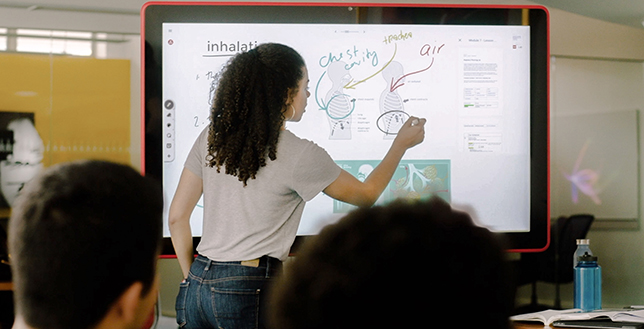
BenQ Google Jamboard Promotion

"As the 2021-2022 new school year begins, we recognize there are still a lot of changes and uncertainties ahead. Some schools are going back to in-school learning, some are remaining virtual, and some are adopting a combination of the two," said Penny Su, BenQ America's business unit director for Google Jamboard and enterprise collaboration solutions, in a press release. "Jamboard is designed to create digital equality in hybrid classrooms and provide teachers with an intuitive, interactive solution that is proven to increase student engagement."

More information about the promotion is available on the BenQ website.

About the Author

Dian Schaffhauser is a former senior contributing editor for 1105 Media's education publications THE Journal, Campus Technology and Spaces4Learning.

Featured

  • Rethinking K-12 Schools as a Continuous Learning Experience

    Most students move through three or more separate facilities during their K-12 journey, yet the built environments they encounter at each stage have traditionally been designed in isolation, with little continuity in spatial language, learning philosophy, or physical resources. Each new school is a reset with different layouts, learning models, expectations, and ways of moving through a building. The next generation of school design is making the case that the first day of kindergarten and the last day of high school can and should feel connected through common support systems and infrastructure in the physical environment.

  • Planning with Clarity: Using AI to Make Better Campus Decisions, Not Just Better Designs

    Higher education leaders are being asked to make increasingly high-stakes decisions about campus facilities amid greater uncertainty than ever before. Social and economic pressures, shifting enrollment, and evolving learning models compete with growing deferred maintenance needs to strain even the most robust infrastructure budgets.

  • Virginia Tech Tops Out New College of Engineering Building

    Virginia Tech in Blacksburg, Va., recently celebrated the topping out of Mitchell Hall, which will soon stand as the largest College of Engineering building on campus, according to a news release. The university partnered with Skanska on the 285,500-square-foot facility, which has an expected completion date of winter 2028.

  • Children walking along bright school corridor with motion blur

    How Next-Gen Design Is Reshaping the Student Experience

    The environments where students learn play a crucial role in shaping their growth in and out of the classroom. By centering design on well-being, flexibility, and purpose, districts can ensure their facilities remain vibrant community assets for many years to come.