Kent State Breaks Ground on Aeronautics and Engineering Building Expansion
Kent State University in Kent, Ohio, recently broke ground on a 44,000-square-foot expansion to its Aeronautics and Engineering Building. The new space will contain amenities like collaborative spaces, teaching and research labs and administrative space. The renovation project comes as the College of Aeronautics and Engineering’s enrollment has increased by 53.6% since 2018 and 7% since 2020.
A gift from The Timken Foundation of Canton to the tune of $1.5 million helped the university move up the timeline of the project, whose overall price tag is an estimated $19.6 million. The facility’s new, two-story atrium will be dedicated to the foundation. University administrators have also reallocated about $12 million internally to support the physical space necessary to properly train students in designing, building and operating advanced technology.
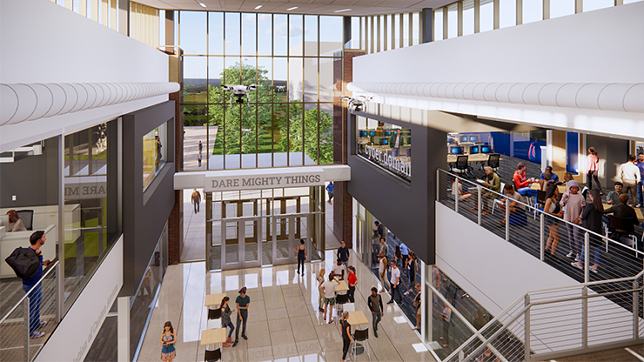
The rendering shows the two-story atrium of Kent State University’s Aeronautics and Engineering Building expansion.
“The successful completion of this project as part of our master plan will support Kent State’s ability to produce the highly qualified STEM graduates needed for the state’s and region’s manufacturing and engineering sectors,” said Kent State President Todd Diacon. ‘We’re very grateful that The Timken Foundation of Canton has partnered with us to enable the College of Aeronautics and Engineering to contribute eve more to the sustainability of the region’s engineering and manufacturing workforce—a vision both organizations share.”
The building’s expansion will feature a two-story atrium that will also serve as a space for members of the unmanned aircraft systems flight operations program to fly indoors. It will also include a 3,000-square-foot auditorium; Maker Alley, which will include three teaching labs (the Pattern and Fabrication Laboratory, the Maker Space and the Design and innovation Laboratory); the cyber.domain, which will consist of a Cyber Range Laboratory, esports arena and Networking and Server Laboratory; and a Simulation and Cybersecurity Laboratory.
“Kent State recognizes the importance of virtual education in this rapidly changing landscape of higher education,” said Christina Bloebaum, Ph.D., dean of Kent State’s College of Aeronautics and Engineering. “The new expansion will also incorporate the latest technology to enable synchronous delivery of virtual education. The expansion’s two new classrooms, as well as teaching laboratories, will be equipped to enable virtual delivery in a streaming, synchronous mode, which will also support the college’s efforts to create pathway opportunities with our Regional Campuses and partner organizations.”
The university officially broke ground on the project on Friday, Oct. 1, as part of its Homecoming Weekend.
About the Author
Matt Jones is senior editor of Spaces4Learning. He can be reached at [email protected].