Kent State to Build New College of Business Admin
- By Dian Schaffhauser
- 10/26/21
Kent State University recently approved construction of a new $74 million, 145,000-square-foot building to house its College of Business Administration. It will be named after the individual who has made the largest donation Kent has ever received. Edward Crawford, an Ohio businessman who served as the U.S. ambassador to the Republic of Ireland under the previous administration, donated an unspecified amount to the university. The new structure will be named Crawford Hall, and the college will be renamed the Ambassador Crawford College of Business and Entrepreneurship.
The university said the new Crawford Hall will support "innovative instruction, research and student support services for thousands of business majors, minors and others taking business courses across the Kent State system." The building design is intended to increase its use of technology to support instructional methods introduced during the pandemic and provide flexible spaces various instructional layouts. The new structure will integrate learning laboratories, classrooms, offices, informal gathering spaces, common areas and business partner spaces.
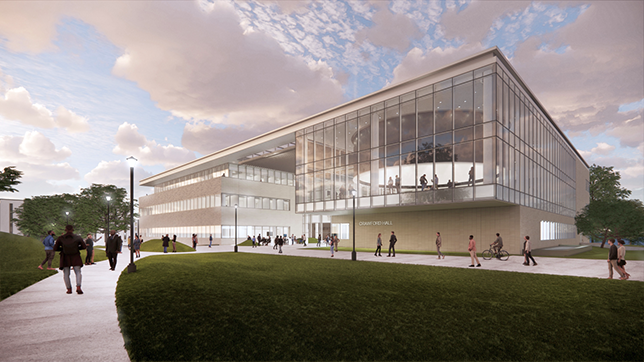
The rendering shows the south facade of Crawford Hall, the new home for the Ambassador Crawford College of Business and Entrepreneurship at Kent State University.
Source: The Collaborative Inc. and Perkins&Will
Construction is expected to begin in December 2021 with classes moving in during August 2024. Building design is being handled by The Collaborative, Perkins&Will and Signet Development.
"Crawford Hall will be instrumental in how we prepare students for modern business careers," said Deborah Spake, dean of the college, in a statement. "This new building – which will be one of the largest buildings on any Kent State campus to house an academic program – and its enhanced technology will continue to bolster our reputation for both international business and entrepreneurship education. We anticipate a continued increase not only in domestic enrollment but also for international students seeking a top-tier education."
The donation comes during the university's latest campaign, "Forever Brighter," which has set a $350 million goal—the largest ever in the institution's history.
About the Author
Dian Schaffhauser is a former senior contributing editor for 1105 Media's education publications THE Journal, Campus Technology and Spaces4Learning.