Saint Francis University Debuts Sensory Room

Saint Francis University in Loretto, Penn., recently debuted a sensory room as space for students with neurodiverse sensory needs. A news release calls Saint Francis one of a “handful of universities” in the U.S. with a specifically dedicated such space.
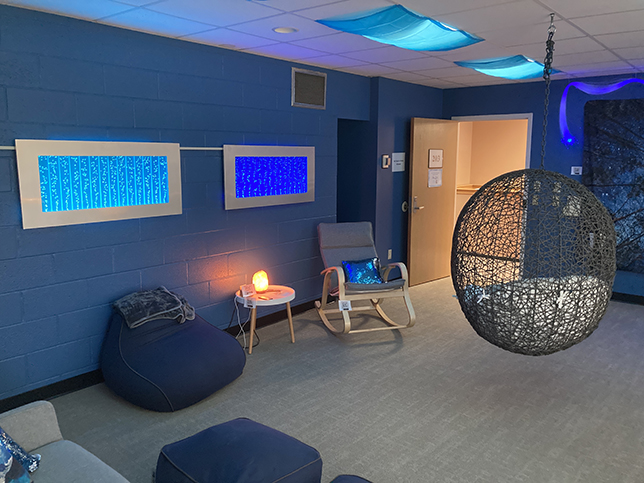
Saint Francis University Sensory Room
Photo courtesy of Saint Francis University

The room is located in the campus library and includes a variety of equipment and activities—along with instructions and information regarding their benefits—for all aspects of the student population’s sensory needs. Between classrooms, residence halls, dining halls, shared bathrooms and more, a university environment may overwhelm students’ eyes, ears, noses and general sense of wellbeing. Added to potential mental health issues related to being away from home for the first time (not to mention the backdrop of the pandemic), the space is intended to be a soothing, calming environment.

The effort was spearheaded by four fifth-year graduate occupational therapy students as a project for their “Role Emerging Level II Fieldwork Experience” on campus. Working with the university, Centers for Academic Success, the Occupational Therapy Department and the library, the students said that they noticed a student need and planned the sensory room as a problem-solving solution.

About the Author

Matt Jones is senior editor of Spaces4Learning. He can be reached at [email protected].

Featured

  • Health & Science Building

    Health & Science Building

    Established in 1999, the Education Design Showcase is a vehicle for showing off innovative — yet practical — solutions in planning, design, architecture, and construction. The College of Western Idaho's Health & Science Building has been recognized with an EDS 2026 Project of Distinction award in the category of New Construction.

  • University of Kentucky Reopens Scovell Hall

    The University of Kentucky recently reopened Scovell Hall, part of the Martin-Gatton College of Agriculture, Food and Environment (CAFE), following comprehensive renovations to the 120-year-old facility in Lexington, Ky., according to a news release.

  • Building Beyond Simulation: Creating Immersive Ecosystems for Healthcare Education

    Health sciences education is one of the fastest-growing facility types in colleges and universities. The demand for medical, nursing, and allied health professionals is driving the creation and renovation of medical simulation training facilities that provide students with real-world experience through advanced simulation-based learning.

  • Dallas ISD Voters Approve $6.2B Bond Package

    Dallas ISD voters have approved a record-setting $6.2-billion bond package that district leaders say will modernize aging campuses, eliminate portable classrooms and reshape learning environments across one of the nation’s largest school systems.