Construction Complete on $6.1M Early Childhood Center

Construction management firm Kraus-Anderson recently announced that it has completed construction on the Early Childhood Center for Pine Island Schools in Pine Island, Minn. The facility stands two stories, covers 20,356 square feet, and cost $6.1 million, according to a news release.

The space includes amenities like new classrooms and a 2,000-square-foot multipurpose area. It also includes an outdoor playground, an indoor playground, administrative space, and ADA accommodations including an elevator. The building also serves as a storm shelter for the safety of students, teachers, and staff.
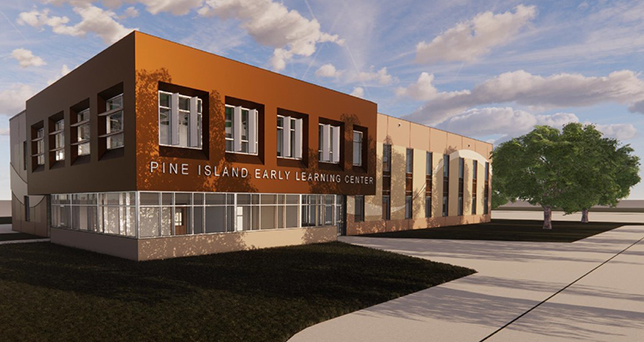
Pine Island Early Childhood Center
Photo Courtesy of Kraus-Anderson

The facility was designed by Wendel Architects.

The news release also reports that over the last five years, Kraus-Anderson has completed more than $1 billion in K–12 projects, ranking 20th in the country in the construction of K–12 facilities.

About the Author

Matt Jones is senior editor of Spaces4Learning. He can be reached at [email protected].

Featured

  • Arlington High School

    Arlington High School

    Established in 1999, the Education Design Showcase is a vehicle for showing off innovative — yet practical — solutions in planning, design, architecture, and construction. Arlington High School has been recognized with an EDS 2026 Grand Prize award in the category of New Construction.

  • Texas Recruitment

    Texas Recruitment

    Established in 1999, the Education Design Showcase is a vehicle for showing off innovative — yet practical — solutions in planning, design, architecture, and construction. The University of Texas at Austin's Texas Recruitment has been recognized with an EDS 2026 Grand Prize award in the category of Renovation.

  • Higher Ed is Betting on New Buildings While Quietly Undermining Their Campuses — Here’s Why

    In this climate, the owner’s representative has changed from a delivery-focused advisor to a strategic campus partner. Institutions are increasingly relying on owner’s reps not just to manage, cope, schedule, and budget, but also help evaluate whether a project should proceed at all.

  • Designing for Every Mind

    Learning environments have the power to shape not just what students know, but who they become. When a school is designed with genuine empathy—for the full range of ways students think, sense, and engage with the world—it becomes more than a building. It becomes a catalyst for growth, confidence, and belonging. That is the animating idea behind neurodiverse design, and it is one that is transforming how more architects and designers are thinking about school design.