Purdue Celebrates Grand Opening of Large Esports Facility
Purdue University has officially opened a new gaming lounge for students training and competing in esports as well as casual gamers. The institution partnered with Dell Technologies to outfit the 2,000-square-foot-space with Alienware gaming equipment. Dell/Alienware will also provide annual esports scholarship funding during the term of the partnership.
The Alienware Purdue Gaming Lounge (APGL) is one of the largest dedicated collegiate gaming facilities in the country, according to the university. It is equipped with 22 Alienware gaming desktops, three Alienware gaming laptops, a Nintendo Switch, and a PlayStation 5. The space includes a broadcast studio for producing and streaming video content, a training and review room, a viewing lounge, and more. In a soft launch this summer, students were able to utilize and provide feedback on the technology, "giving staff time to tweak systems to their highest performances levels," the university said.
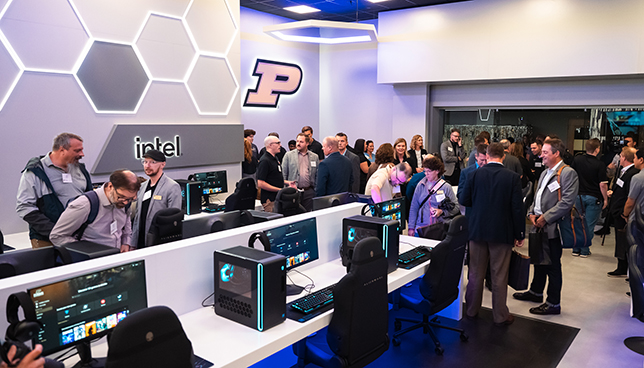 Purdue University's Alienware Purdue Gaming Lounge (photo courtesy of Purdue University)
"Whether students are looking to get casually involved or compete at higher levels, we are excited to support gaming here at Purdue RecWell, showcasing the latest technology," commented Mike Warren, senior director of Recreation & Wellness at Purdue, in a statement. "This space is about more than gaming; it's about developing social connections, finding a community, and creating a sense of belonging. We believe it will attract students to RecWell who may have never set one foot inside the facility. Once here, the students will see the entire intersection of diverse offerings for holistic well-being."
"Watching the students walk into this beautiful facility and hearing their enthusiastic feedback over the Alienware technology has been rewarding to witness. It validates Purdue's investment in the space and our strategic partnership with Dell Technologies to embolden Boilermaker gamers — from novices to varsity-level players — to engage at the highest levels of esport competition," said Beth McCuskey, vice provost for student life. "These students are learning in environments that you wouldn't find in any other type of setting like this. They're gaming together. They're strategizing. They're communicating. They're problem-solving. And they're learning soft skills that will help them stand out in the job market."
"Esports gaming technology is not just about bolstering the next generation of gamers competing to their best abilities; it's about inspiring the future of discovery," said Matt McGowan, general manager of Alienware. "This partnership between Alienware and Purdue will empower players and support those gamers in becoming the next generation of innovators, engineers and researchers that Purdue has built its academic reputation on."
About the Author
Rhea Kelly is editor in chief for Campus Technology, THE Journal, and Spaces4Learning. She can be reached at [email protected].