University of Florida to Start Construction on New Agricultural, Engineering Building

The University of Florida in Gainesville, Fla., recently announced that it will soon begin construction on a new academic building for the department of agricultural and biological engineering (ABE), according to a news release. The W.W. Glenn Teaching Building is scheduled to begin construction by the end of 2024 and finish by August 2025, in time for the new academic year.
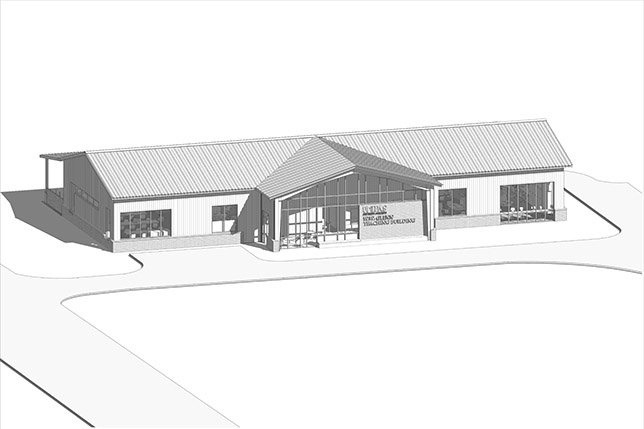
Image courtesy of University of Florida

The new facility will cover 7,200 square feet, more than twice that of the existing ABE building. The facility will include a mechanical workshop and an engineering design workshop, among other amenities.

“The new building will provide our students with state-of-the-art, hands-on learning experiences to further explore technology, innovation and creative design, preparing them to be our future problem-solvers for agricultural and natural resource challenges,” said ABE chair Kati Migliaccio.

The building was funded through donations from the university community. It was named after UF graduate and University of Florida Institute of Food and Agricultural Sciences (UF/IFAS) Extension agent W.W. Glenn, whose family provided financial support to the project.

“These extremely generous gifts will enable us to train the next generation of leaders to help natural resources and the environment in Florida, as well as the world as it continues to grow and change,” said Daniel Hofstetter, a university assistant professor in agricultural construction and maintenance, at the groundbreaking ceremony. “Today, we're not only breaking ground for a new building, but we’re also breaking barriers in our teaching program.”

About the Author

Matt Jones is senior editor of Spaces4Learning. He can be reached at [email protected].

Featured

  • Rethinking K-12 Schools as a Continuous Learning Experience

    Most students move through three or more separate facilities during their K-12 journey, yet the built environments they encounter at each stage have traditionally been designed in isolation, with little continuity in spatial language, learning philosophy, or physical resources. Each new school is a reset with different layouts, learning models, expectations, and ways of moving through a building. The next generation of school design is making the case that the first day of kindergarten and the last day of high school can and should feel connected through common support systems and infrastructure in the physical environment.

  • Spaces4Learning Announces 2026 Product Award Winners

    Spaces4Learning has just announced the winners of the 2026 Product Awards! The award program spotlights outstanding product development achievements of manufacturers and suppliers whose products or services are considered to be particularly noteworthy in their ability to enhance K–12 and higher-education learning environments.

  • Wold Completes Geothermal Projects at Two Minnesota Schools

    Wold Architects & Engineers recently announced that it has completed two geothermal expansion projects for Mounds View Public Schools in Shoreview, Minn., according to a news release. The work at Highview Middle School and Irondale High School serves the district’s long-term goal of reducing energy costs and dependency on non-renewable fuel sources, as well as improving building performance.

  • Cal Poly Humboldt Starts Construction on Healthcare Education Hub

    California State Polytechnic University, Humboldt in Arcata, Calif., recently announced that work has begun on a renovation project that will turn the Stewart Building into a new Healthcare Education Hub, according to a news release. The university is partnering with Sundt Construction Inc. for construction services.