New Outdoor Benches Make Campus Stand Out
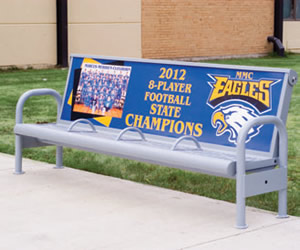
Steel Benches 

The changeable signboards on RJ Thomas’s durable steel benches and help add unique flair to many college campuses in the University of California System.

It's become increasingly clear that outdoor amenities and landscape design are playing a significant role on college campuses across the country. Across The University of California (UC) system, durable steel benches from R.J. Thomas Mfg. Co. offer a changeable sign board that can be used in many different and beneficial ways. UC Facility Manager Floyd Lawson intends to promote campus events and various academic programs. “Our benches are an ideal tool to generate awareness,” he says.

The all-steel bench is powder-coated and thermoplastic-coated in your color choice. Behind the custom sign is a supporting piece of ¾-inch marine grade plywood. The backrest includes a lockable frame to secure your custom signage. Three bench and sign sizes are available — four, six or eight feet long. All signs are 24 inches tall.

Lawson went on to say, “We like the flexibility to change the signage as often as we want, and the backrest can be saved and reused again.”

The backrest sign is a durable .040 gauge aluminum laminate with a ¼-inch polycarbonate core. Any custom graphic will be digitally printed on 3M vinyl material.

R.J. Thomas Mfg. Co. makes the Pilot Rock brand of campus, park and streetscape furniture. Made in the U.S. since 1959, their product line includes many designs of campus outdoor amenities including: park benches, picnic tables, bike racks, trash and recycling receptacles, and ADA-compliant wheelchairaccessible products.

www.pilotrock.com

This article originally appeared in the issue of .

Featured

  • Embry-Riddle Completes Construction on Research, Lab Facility

    Embry-Riddle Aeronautical University (ERAU) in Daytona Beach, Fla., recently announced the end of construction on a new research and lab facility on campus. The Center for Aerospace Engineering II (CAT II) will support aerospace research and technology development and broke ground last summer.

  • Designing the Bridge Between Inclusivity and Independence in K–12 Schools

    Fostering independence is fundamental to learning and development for K–12 students. It offers many proven benefits, such as enhanced confidence, problem-solving, decision-making, and social skills. However, this foundational objective loses its impact if it’s not accessible and adaptable to all students. Inclusivity plays a critical role in cultivating independence and healthy autonomy for students, fostering positive student learning outcomes by uniting pedagogy with the physical learning environment.

  • Year-Round Schools Require Year-Round Indoor Air Quality Planning

    While many schools are out for the summer, year-round schools follow a more “balanced” schedule with shorter, more frequent breaks spaced throughout the school year. Even though this offers educational benefits, these facilities have less downtime for building maintenance. This can become an issue when facilities managers overlook the importance of routine HVAC maintenance and air duct cleaning services.

  • Planning with Clarity: Using AI to Make Better Campus Decisions, Not Just Better Designs

    Higher education leaders are being asked to make increasingly high-stakes decisions about campus facilities amid greater uncertainty than ever before. Social and economic pressures, shifting enrollment, and evolving learning models compete with growing deferred maintenance needs to strain even the most robust infrastructure budgets.