Restrooms Around the World
- By Dr. Thomas Keating
- 03/01/15
During the week following the Martin Luther King Jr. national holiday, three toileteers visited selected schools in two school districts east of Atlanta for the purpose of working with students on the cultural aspects of sanitation.
The Executive Director of the German Toilet Organization (GTO), the coordinator of Project CLEAN (Citizens, Learners, and Educators Against Neglect), and the founder of the Canadian Toilet Organization interacted with pupils in grades five through 12, in the DeKalb County and City Schools of Decatur districts.
More than 300 students in health, engineering, biology, environmental health, anatomy, world geography and some student government representatives hosted sessions primarily led by Mr. Thilo Panzerbieter, who has led the GTO for 10 years.
In addition to a debate on the merits of hand towels versus air dryers, informal meetings were also held with custodians, teachers and parents.
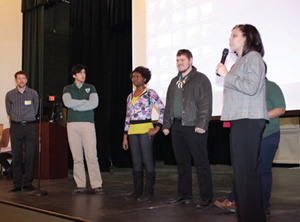
PHOTO COURTESY OF ASHLEY OGLESBY
After watching a video provided by tippytap.org, Principal Michelle Jones encouraged students to talk about what they had learned from the film. Executive Director of the German Toilet Organization (GTO) Thilo Panzerbieter, far left, explains how it relates to what they are learning in their classes.
The three sanitation leaders, who have approximately 40 years experience among them, including school-related work in Berlin, DeKalb County, Ga., and numerous countries including Ethiopia, Nepal, China, Sri Lanka, Ireland and India, discussed different cultural aspects of wellness and toiletry with students.
In one DeKalb County high school, students from 50-plus nations viewed two videos and a still-life picture, all which illustrated simple solutions to hand washing, classic toilet types and community approaches to improving sanitation.
The school principal led an interactive discussion with all the assembled upper classmen. Students from each class then came to the stage and spontaneously spoke to the 160 attending students about what they had learned from the films and how it related to their classes and school restrooms.
Junior and senior high students studying the professions associated with health care, who are also members of HOSA-Future Health Professionals, formerly known as Health Occupations Students of America, a national career and technical student organization, questioned Panzerbieter and Dr. Tom Keating, founder of Project CLEAN, about sanitation experiences in other countries.
Following these presentation, the pictorial book “Toilets of the World” by Gregory and James, shelved in a special sanitation section of the media center, was checked out.
Sixth-eighth grade student government leaders discussed another video on community-based solutions to improving sanitation.
At one session with fifth graders in a City School of Decatur, the following aggregate dialogue took place.
“Why doesn’t the Western world squat like in the East?”
“Historically, who sat for much of the day?”
“Royalty.”
Part of the evolution to a sitting public in England and other western cultures was from kings and royalty sitting. Perhaps, our sitting on “the throne,” is a direct descendent from this lineage.
Students were also fascinated by Ari Grief, founder of the Canadian Toilet Organization, who has accumulated 160 hours of footage about restroom issues world-wide, when he spoke about the cultural adaptation of high heels for women, worn in earliest days to avoid mud and human sludge on dirt streets.
In all four schools visited by these school restroom advocates, students took away cultural sensitivities and a greater awareness of the connection between local school issues and global sanitation concerns.
Some groups of students have begun discussing World Toilet Day, proclaimed by the United Nations, to be celebrated on Thursday, Nov. 19, 2015.
This article originally appeared in the issue of .
About the Author
Dr. Tom Keating, a leading advocate for improved student restrooms in public schools, has worked since 1994 in DeKalb County, Georgia, over twenty States, and six countries, often in partnership with the German Toilet Organization. He can be reached at [email protected] and thought he ProjectCllean website, www.projectclean.us.