East Greenwich Public Schools
Project Snapshot
PROJECT: Cleaning for Healthy Schools
LOCATION: East Greenwich, R.I.
COMPANY NAME: ProTeam, the Vacuum Company
WEBSITE: www.pro-team.com
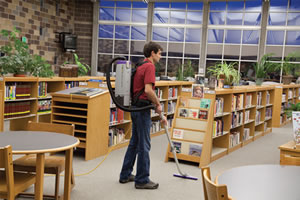
Keeping the air clean is important, especially in a learning environment. At East Greenwich School District, clean carpets are a major part of this and they look to Pro-Team for effective solutions.
THE CHALLENGE
School District Reduces Particulate Matter with HEPA Vacuums. Eight years ago an Indoor Air Quality (IAQ) technician inspected the four elementary schools, middle school, and high school that comprise East Greenwich Public Schools in Rhode Island. She observed a lot of particulate matter in carpeted areas and warned school officials about the possible health impact.
Particulate matter is microscopic solid or liquid particles that suspend in the air, including dust, pollen, dander, soot, smoke, etc. Particles smaller than 10 microns in diameter (a micron is a millionth of a meter or one thousandth of a millimeter) can be breathed into the lungs, presenting a health threat to sensitive populations like those with asthma and allergies.
The IAQ technician made a recommendation based on her findings: switch to ProTeam vacuum cleaners. This would reduce allergens and asthma triggers while creating a healthier and safer learning environment.
THE SOLUTION
The school district made the switch. They now use ProTeam upright vacuums, the ProForce 1500XP HEPA and the ProGen 15, to clean carpeted areas, and ProTeam backpack vacuums, the Super CoachVac HEPA and the Super Coach Pro 10, for hard flooring. The cleaning staff had never worked with backpack vacuums before and was uncertain about the switch.
“There was resistance to the change initially,” says Bob Wilmarth, director of Facilities and 10-year veteran of the school district. “Over the course of time, the staff has grown to like the backpacks. They are true timesavers.”
IMPACT ON LEARNING
For Wilmarth, these efforts added up to creating a healthy learning environment for students. He has been heavily influenced by Rex Morrison’s work with the nonprofit consortium Process Cleaning for Healthy Schools (PC4HS) and uses a hybrid of PC4HS, team cleaning, and traditional zone cleaning. This blend of styles works for Wilmarth’s staff of 20 and keeps the health of the indoor environment a top priority.
“If we are spreading germs while cleaning, that leads to less time with students in their seats,” says Wilmarth. “It is my firm belief that the more students are in their seats with a high level of Indoor Air Quality and good lighting, the more learning takes place.”
Editor’s Review
The U.S. EPA’s 2010 study, entitled “How does Indoor Air Quality Impact Student Health and Academic Performance?” states, “Substandard environmental conditions in schools, such as insufficient cleaning or inadequate ventilation, can cause serious health problems for children.” It goes on to say that it also directly impacts student academic performance. This project is an example of providing a better learning environment where students feel safe and confident that their school is providing them with a healthy environment. Not only does this mean that students and teachers need to take less sick days, but the more relaxed, healthy attitude allows them to dedicate their full attention to teaching and learning.
This article originally appeared in the issue of .