Largest K-12 Photovoltaic Roof Top Solar System in Virginia
Created through Virginia Public School Division and Dominion Virginia Power partnership.
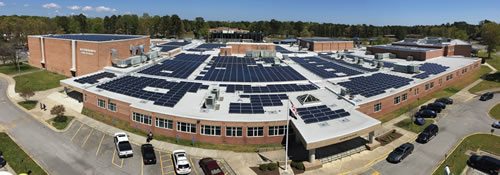
PHOTO COURTESY OF DOMINION VIRGINIA POWER
Dominion
Virginia
Power, Standard
Solar and Chesapeake
Public schools
recently partnered to
install more than 3,000
photovoltaic solar panels
on the rooftop of Western Branch High
School, in Chesapeake, Va. This rooftop
system has the capability to generate almost
one megawatt of energy. The electricity
generated can produce enough energy to
supply power to over 250 homes. Western
Branch High School became the first school
to participate in Dominion Virginia Power’s
Solar Partnership Program. Dominion
Virginia Power chose this high school based
on several conditions that were needed to
make the project a success. One condition
was having a new flat roof and the other
component included the relationship to the
energy grid that Dominion Virginia Power
wanted to supply power to.
The partnership allows Dominion Virginia
Power to lease the rooftop space for
a minimum of 15 years with an option to
expand five years thereafter. The electricity
generated from the panels goes directly to
the Dominion Virginia Power grid. There
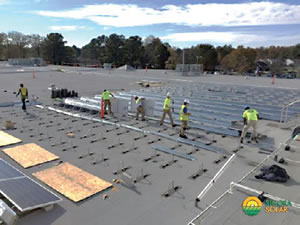
was extensive planning that took place
including the layout design of the panels
on the roof. This was important to ensure
access needed for maintenance crews.
The panels have a wind rating of up to 140
miles per hour.
 Another benefit of this partnership
is the educational component. Dominion
Virginia Power included training for
teachers along with related materials
designed to provide a hands on learning
approach so students will have a better
understanding of solar generated energy.
The program also provided two interactive
kiosks in the school, which allows
students and stakeholders to review live
energy data along with other energy tools
and designations for energy uses. The link
for the school can be found at
www.solarems.net/kiosks/396.
Another benefit of this partnership
is the educational component. Dominion
Virginia Power included training for
teachers along with related materials
designed to provide a hands on learning
approach so students will have a better
understanding of solar generated energy.
The program also provided two interactive
kiosks in the school, which allows
students and stakeholders to review live
energy data along with other energy tools
and designations for energy uses. The link
for the school can be found at
www.solarems.net/kiosks/396.
There are resources and grants that
allow school divisions to be creative
in ways of supporting sustainable and
renewable energy sources. The students
at Western Branch High School, in Chesapeake
get to experience this first hand.
Solar and wind energy initiatives are still
growing in interest and understanding.
It is important to continue to expose
students and communities to the future
of renewable energy sources that help our
environment.
This article originally appeared in the issue of .
About the Author
John A. Bailey, Ph.D. is the director of School Plants for Chesapeake Public Schools and a National School Plant Managers Association board member, representing Virginia, and a Virginia School Plant Managers Association board member, representing Region II, in Virginia.