Lighting Solutions Brighten Pavillion
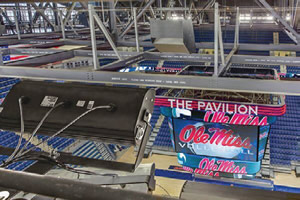
Decreasing the need for maintenance and using less
energy were just two of the benefits Hubbell Lighting
offered Ole Miss through the use of their Sportsliter Solutions’
ArenaLED.
Meet the highest level of NCAA lighting standards —
The National Championship
finals site. In this standard the NCAA maps
out the best practices for lighting quality for
player safety, reduced energy, maintenance
and life-cycle costs, environmental sensitivity
and the horizontal and vertical foot-candle
requirements for the TV broadcast.
The architect, AECOM, has a longstanding
working relationship with Lighting
Associates, Inc. and trusted them to recommend
a solution that would meet these challenges.
Eighty-four ArenaLED fixtures are
used to light up the main floor of The Pavilion
at the University of Mississippi (Ole Miss).
The advancements in LED technology
made it the clear favorite to light up the facility. Most importantly, it exceeds the guidelines
set forth by the NCAA. But is has also reduced the energy needed to light up the floor by half,
significantly decreased the need for maintenance
and provided facility managers with
the ability to enhance the fan experience with
contemporary lighting techniques.
“The excitement levels for the fans,
faculty and staff were sky high when The
Pavilion at Ole Miss opened. The lights themselves
are a significant factor in this and the
performance thus far has absolutely met our
expectations. We look forward to creating
some significant memories in this facility,”
says Joe Swingle, senior associate A.D. for
Facilities and Game Operations at Ole Miss.
Hubbell Lighting’s Sportsliter Solutions’
ArenaLED is an LED lighting solution
designed for interior sports and civic arenas
to produce optimal television and liveaudience
viewing, as well as low-glare lighting
for player comfort. The solid-state LED
delivers immediate on/off capabilities, as
well as 40,000 lumens at 92+ lumens perwatt
for a calculated 100,000 hours. With
a total system wattage of 415, the fixture’s
extruded, finned housing design allows
for optimal heat dissipation, and a remote
driver enclosure offers increased thermal
control and ease of maintenance.
www.hubbelllighting.com
This article originally appeared in the issue of .