The Choice is Yours
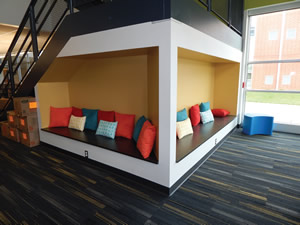
PHOTO © SCOTT BERMAN
Ease of maintenance, affordability, durability and
health and safety: They all weigh heavily on school districts’
choices for carpet and flooring.
Nothing new there, but how do such factors impact the look
and aesthetic of floors today? Must there be a trade-off as districts
seek the very best possible interiors to meet needs and support
their educational mission?
Districts across the United States are responding variously.
Some current ways were evident in a recent visit to Bristol Township
School Districts’ Mill Creek Elementary and Harry S. Truman
High, both in Levittown, Penn. At the newly constructed Mill
Creek, Bob Maloney, operations director, and Mill Creek architect
Bruce Bachtle, partner, Schradergroup Architecture, pointed out
design elements and flooring varieties, including rubber, vinyl
composite tile (VCT) and carpet tile. At the decades-old high
school, long expanses of refinished terrazzo caught the eye. At both
schools, flooring and carpets had an attractive color palette, with
accents, trim corresponding furniture and lighting complementing fine finishes on new and older flooring alike.
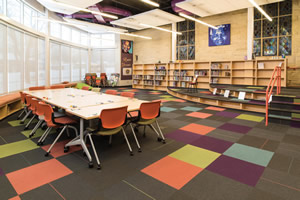
PHOTO © SCOTT BERMAN
The district, faced with cost and time constraints, has implemented
a proactive maintenance program, with Maloney describing
routines that use fewer chemicals and get good results. In short, the
district has gone with nuanced differences that pertain to floor type:
For example, auto scrubbers and floor pads to prepare, clean and
polish floor types such as VCT and terrazzo, to which a robust sealer
has been applied, with the VCT finished with two layers of wax atop
the sealer, and fresh urethane layers on maple gym floors. Typically,
the auto scrubbers use only deionized water instead of chemicals,
and Maloney is pleased with the results. Around the district, the
proactive approach has sped things up, and floor finishes are looking
good, Maloney adds. The impetus: to make floor maintenance as
efficient and cost effective as possible.
Of course, ease of maintenance and affordability are crucial
whatever the flooring type, and there is a wide range of options,
including premium rubber flooring. The rubber flooring approach
provides many options in terms of color, texture and patterns, explains Tim Cole, vice president of marketing
at nora systems, Inc., and with these
options come easy maintenance. Stripping,
waxing and sealing are not regularly required,
“saving valuable time in the cleaning
process and the costs associated with
purchasing those products,” Cole points
out. Further, brand-specific scrubbing pads
are part of a nora cleaning system designed
to cut time, cost and the use of detergents
and chemicals.
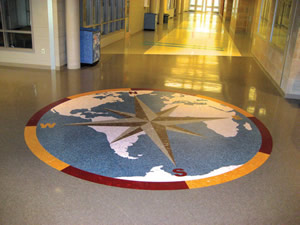
PHOTO © SCOTT BERMAN
To take another example, various
districts are going with textile composite
flooring. It’s a choice that J+J Flooring
Group’s Bob Bethel, director of Business
Development, Education, says “can
withstand the intense wear and tear of a
K-12 school environment, while keeping
its appearance for multiple years.” Further,
Bethel explains that a J+J product, Kinetex,
is designed accordingly for cleaning with
vacuums and hot water extraction.
As Lauri Watnee, Mohawk Group’s
director of Institutional Markets, explains,
some “fiber technologies provide the ability
to clean most stains with only water, reducing
the time spent on maintenance, the
amount of chemical needed to clean, and
keeping the residue out of the breathing
environment. Other positive attributes may
be fiber systems that are capable of resisting
the chemical loss of color due to bleach
or hydrogen peroxide cleaning chemicals.”
Such maintenance options do not limit
opportunities to use carpets and flooring
to make bold design statements — in fact,
quite the opposite today. As Bethel puts it,
“We don’t see schools needing to sacrifice
a highly aesthetic flooring for an easy-to-clean/maintain flooring. K-12 facility decision
makers can seamlessly combine high
design with easy-maintenance flooring.”
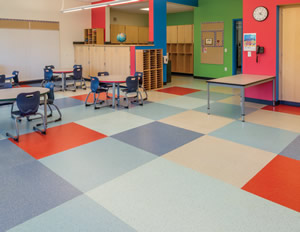
PHOTO © NORA SYSTEMS INC.
Cole also notes an infusion of color in
school interior designs, including rubber
flooring that can be customized with vibrant
floor inlays that fuse aesthetic appeal with
practical purposes. As Cole explains, “inlays
can be used as a design element or educational
tool. Inlays also offer a wayfinding device,
which can be so important to children as they
navigate through a large building, moving
from one class or activity to another.”
This writer has seen a variety of floor
logo and mascot designs in schools. In one of the interesting takes, a large, attractive map
of the world with cardinal directions was
recently created in a student project at Silver
Spring, Maryland’s Wheaton High School.
A more routine example is a school district
logo emblazoned on the VCT flooring in the
main lobby of Mill Creek Elementary. However,
the logo’s color scheme is an elegant
complement to the overall interior design of
the school, where other flooring approaches,
such as carpet tile in the school’s attractive
library, also reflect and amplify the design.
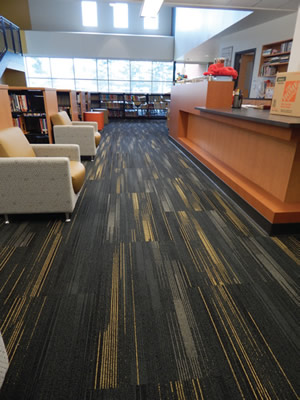
PHOTO © SCOTT BERMAN
Logo or not and whatever the product,
vivid color makes a well-chosen, well-maintained
floor pop. Examples abound. Among many, many others, there are:
the bold, bright hues adorning classroom
floors by nora systems at Christa McAuliffe
School in Concord, New Hampshire; pattern
and colors that come together with a
sense of fun and elegance in a J+J Flooring
installation at Nelson Mandela Elementary
in Omaha, Nebraska; and Mohawk Group’s
sustainable, richly colored and textured
carpet — youngsters helped provide
design ideas — at Phipps Conservatory’s
SEEDclassroom facility in Pittsburgh.
So even with maintenance and other
factors to consider, there is not necessarily
a trade-off with aesthetics today. And
as Watnee adds, “the flooring industry
is exciting and innovative, constantly
developing new visual and performance
enhancements that create beautiful spaces
in which learning can happen.”
Some recommendations about selecting
the right carpet and flooring system
for a school:
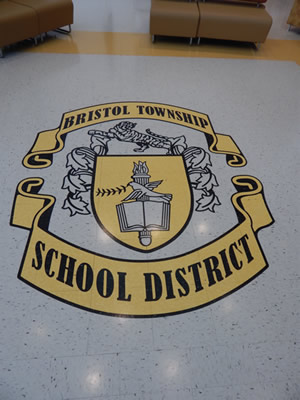
PHOTO © SCOTT BERMAN
- Consider that a floor, if attractive, durable,
affordable and safe, can reinforce a
school’s identity. For example, when “a
very specific effect, logo or brand statement
is required, the floor can be customized
to meet a school’s unique needs,” Tim
Cole of nora systems, Inc. points out.
- Stay vigilant and curious about the best
possible cleaning approaches, policies
and equipment for your school, as Bristol
Township School’s example indicates.
- Remember that proactive, daily cleaning
of walk-off systems is the first step
toward a clean, long-lasting flooring
system, whatever form it takes, Mohawk
Group’s Lauri Watnee explains.
- Make “sure you have the right flooring
product for the right space, and at the
right price point,” says J+J Flooring’s
Bethel, who also urges facilities decision
makers to ask how any flooring product
may impact design and what maintenance
plans accompany the flooring product.
This article originally appeared in the issue of .