Des Moines Public Schools
Project Snapshot
PROJECT:
Des Moines Public Schools
LOCATION:
Des Moines, Iowa
COMPANY NAME:
EVAC+CHAIR
North America
WEBSITE:
www.evac-chair.com
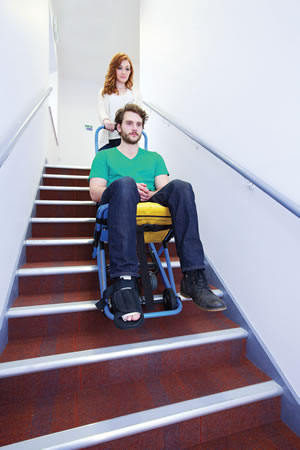
Being prepared for any emergency situation helps to create a great learning
environment. Des Moines Public Schools made sure all of their facilities would
reflect that reality by updating their EOP and adopting EVAC+CHAIR evacuation
chairs.
THE CHALLENGE
The State of Iowa Department
of Education requires that schools
in the state need to be “adequately
prepared for a variety of emergencies
that threaten the young lives of Iowa
students each day.” The Department of
Education also stresses the importance
of having an updated Emergency Operations
Plan (EOP) in order to guarantee
this preparedness. These plans need
to account for every student, including
those with limited mobility.
Many of the 70 buildings in the Des
Moines Public School District had bulky
evacuation chairs stored in classrooms
and closets. These outdated chairs were
not only difficult to set up, but also hard to maneuver up and down stairs.
In reviewing their EOP, Des Moines Public
School officials realized that finding
a better way to evacuate students with
limited mobility would greatly increase
emergency readiness in their schools,
and set out to find a solution.
THE SOLUTION
After researching the various
types of evacuation equipment
available and fielding bids, the school
district went with EVAC+CHAIR. “The
EVAC+CHAIRs were light and easy to
use. We looked at cost, weight, ease of
use, ease of storage, amount of storage
space, etc.,” says Pamela Rosa, safety
compliance specialist for Des Moines
Public Schools. “They have also been
really good at following up and seeing
if we need anything.”
Rosa notes that before, if a school
elevator was out of service, there
was “no way to get students with
physical limitations, down stairs,” in an
emergency. With EVAC + CHAIR, there
is now a plan in place for every student
when it comes to evacuation. Rosa
points out that “the special education
teachers that have students who need
an evacuation plan,” benefitted greatly
when the chairs were purchased.
IMPACT ON LEARNING
Safety should be a priority at
every school — it is what allows
students to learn in a worry-free
manner and teachers to teach without
constantly thinking about what they
will do in case of an emergency. Des
Moines Public Schools have made sure
a safe environment is a reality across all
their schools, by updating their EOP and
with help from EVAC+CHAIR. “Providing
full building access is important in
providing a normal environment for all
students,” concludes Rosa. “It has been
great having something the schools can
utilize to get students down stairs…it’s also the right thing to do.”
Editor’s Review
Since 1990, public
schools have been subject
to Title II of the Americans
with Disabilities Act (ADA),
which requires schools
built after January 26,
1992, to comply with the
federal ADA Accessibility
Guidelines. The ADA
guidelines have become
the de facto “best design
practices” for making
public schools accessible
to individuals with special
needs or disabilities. Eighteen
years after passage of
the ADA, it is accepted that
disabled and special needs
students are housed in
ADA-compliant locations
and can be readily evacuated
in an emergency. Des
Moines Public Schools
recognized the need to replace
their outdated evacuation
chairs with newer,
more user-friendly devices,
making their schools safer
and better prepared.
This article originally appeared in the issue of .