Schools Enhance Campus Communications
The Richgrove School District was able to modernize communication and save time and money by using FrontRow technology.
Located in California, the Richgrove School District is comprised of one school serving 750 K-8 students. Richgrove needed a better way to handle emergency response, paging, bells, and other campus-wide communication. Superintendent Mario Millan identified FrontRow’s Conductor as the solution to modernize communication, save time and money.
Richgrove adopted award-winning FrontRow technology, including: Conductor (networked emergency response, bells and paging) and Juno (sound system plus teacher and student microphones). Richgrove uses the technology to be more efficient, enhance critical and emergency communication and even improve academic results.
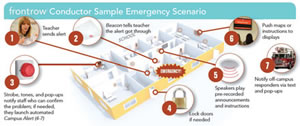
Conductor can help automate critical emergency responses: locking doors, giving verbal instructions, pushing evacuation maps, digital signage and more. “Safety is a priority for us. We want to make sure we have the ability to talk to our kids, talk to our staff, in case of an emergency or just on a daily basis on a regular routine,” shares District Superintendent Mario Millan. One click helps keep students safe. “If we have lightning or a storm I can push the lightning tab,” he adds, “we also have a fire tab, a lockdown and a shelter lockdown.”
Traditional bells and paging systems could no longer handle the school’s most basic needs. Before Conductor, “we actually had to contract someone out to come and change all of our bells,” he states. Userfriendly Conductor effectively helps them save resources and time. Juno teacher and student microphones “allow the staff to communicate with students in a more productive way. It’s a great way to ensure the students have the audio levels they need in their classrooms, for teachers to save their voices and to ensure safety,” concludes Millan.
Richgrove is reducing costs, saving efforts, and achieving more with FrontRow Conductor’s communication technology.
www.gofrontrow.com
This article originally appeared in the issue of .