Preserving History with Pride and Care
Unilock

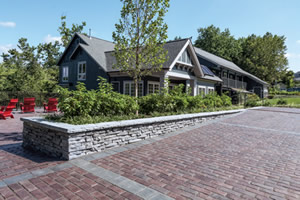
The new admissions building at Miss Porter’s School used Unilock products to help preserve the historical feel of the site while also providing much needed durability.

For over 325 years a building has stood on the east bank of the Farmington River. Once a grist mill, this historic landmark has had the identity of a residence, boutique shop, fabric store, bookstore and even a successful restaurant. In 2014, the building and the land were donated to the Miss Porter’s School — Farmington, Conn.’s premier college preparatory school that excels in academics and athletics. This captivating site would be transformed into the new admissions building.

During the renovation the school saw the importance of preserving the historic features and character. What was once a sea of asphalt parking, the exterior of the site was converted into an arrival garden and accessible walk by The Berkshire Design Group of Northampton, Mass. It was important to find and use materials that would keep the feel of the site and stand the test of time. Unilock Town Hall paver is utilized in the plaza and walkway areas, which are adjacent to the large lawn area, a destination for school celebrations. Unilock Rivercrest Wall system forms a raised planter filled with shrubs, ground covers and bulbs to frame views of the river.

Installation was provided by Starr Contracting, LLC of Avon Conn. With pride and care, the team at Starr incorporated many existing site structures into the whole project, including one of the original mill stones.

This site is an area which will showcase and celebrate Farmington’s history for years to come.

www.unilock.com

This article originally appeared in the issue of .

Featured

  • Building Beyond Simulation: Creating Immersive Ecosystems for Healthcare Education

    Health sciences education is one of the fastest-growing facility types in colleges and universities. The demand for medical, nursing, and allied health professionals is driving the creation and renovation of medical simulation training facilities that provide students with real-world experience through advanced simulation-based learning.

  • How Proactive Maintenance Can Transform Athletic Facilities into Strategic Assets for College Sports

    College athletics is entering one of the most transformative periods in its history. With NIL reshaping financial models and competitive expectations, athletic departments across the country are being asked to do more than ever with increasingly constrained resources.

  • Rethinking K-12 Schools as a Continuous Learning Experience

    Most students move through three or more separate facilities during their K-12 journey, yet the built environments they encounter at each stage have traditionally been designed in isolation, with little continuity in spatial language, learning philosophy, or physical resources. Each new school is a reset with different layouts, learning models, expectations, and ways of moving through a building. The next generation of school design is making the case that the first day of kindergarten and the last day of high school can and should feel connected through common support systems and infrastructure in the physical environment.

  • Georgia State University Opens New Research Tower

    Georgia State University in Atlanta, Ga., recently held a ribbon-cutting ceremony for a new, nine-story, 155,000-square-foot Research Tower, according to university news. Amenities include academic classrooms, a large lecture space, teaching labs, faculty research space, and the uppermost floors reserved for future expansion.