San Jacinto College Breaks Ground on the Center for Petrochemical, Energy and Technology
What turned out to be the largest groundbreaking held at San Jacinto College also introduced construction of the largest petrochemical training facility in Texas.
Elected officials and key petrochemical leaders gathered on Sept. 20, 2017, to witness the groundbreaking and learn about the Center for Petrochemical, Energy and Technology, set to open in 2019. The 145,000-square-foot Center will serve to demonstrate the college’s national Top 5 ranking by delivering highly skilled graduates for the petrochemical manufacturing industry while inviting companies to utilize the facility for their workforce training.
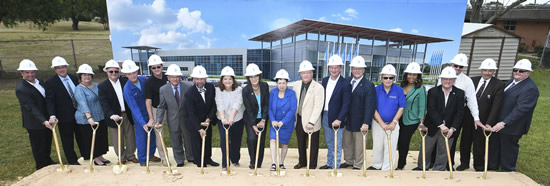
The Texas Gulf Coast region boasts the largest petrochemical manufacturing complex in the U.S., second largest in the world, and is home to 90 companies and 130 plants. The region is working to fill the pipeline with an increased number of certified workers due to $40 billion in announced projects and more than 50 percent of the current employee base retiring over the next few years, according to the East Harris County Manufacturers Association (EHCMA).
“This groundbreaking has been many years in the making,” says San Jacinto College Chancellor Dr. Brenda Hellyer, who formed the Chancellor’s Petrochemical Advisory Council with members from the petrochemical industry to receive advisement on the development of the facility. “From the beginning, this Center for Petrochemical, Energy, and Technology has been a collaboration with our industry partners. There are many companies and individuals who have helped to make this happen by providing their time and input on everything from how the building should look, to the equipment that should be in the building, and the curriculum that we should be teaching. We appreciate their collaboration and participation into making this the premiere training facility along the Texas Gulf Coast."
The Center for Petrochemical, Energy and Technology is a $60 million investment that will house the college’s associate degree and certificate programs for process technology, instrumentation and analyzer technology, non-destructive testing, and electrical technology, complete with program-specific training labs. San Jacinto College currently trains more than 3,600 students annually within the mentioned areas.
An exterior glycol distillation unit and a control room will be constructed to teach process operations and develop troubleshooting skills for entry, advanced credit students and incumbent workers. The Center will also feature a multifunctional glass pilot lab for training process systems. Companies will be invited to work with the college’s Continuing and Professional Development division to create customized and confidential training for employees within an area of the Center dedicated to corporate training and professional development.
“EHCMA values its relationship with the colleges in the area, and we were extremely pleased to be involved in the planning of this tremendous facility with San Jacinto College,” says Bob Bradshaw, plant manager at INEOS and chairman of the EHCMA Board of Directors. Bradshaw adds that rapid growth in the U.S. oil and gas industry is leading to expansion in manufacturing and refining and increased employment opportunities for skilled positions in operations and maintenance. “Through the creation of the Petrochemical Advisory Council, industry leaders and the faculty and staff of San Jacinto College could develop collaborative solutions to meet the future needs of students and industry.”
EHCMA supported the 2015 bond that is helping to fund the Center, and its members have contributed equipment and monetary donations to help with student training. Dow and LyondellBasell have contributed subject matter experts to serve on the steering team. Tellepsen engineers are designing the glycol unit, and LyondellBasell is designing the glass lab. A team from Shell is leading the design of the analyzer lab and providing guidance on instrumentation labs. Hunter Buildings donated a blast resistant building that is now part of most plant sites, and Tracer Construction is providing an electrical heat tracing system for freeze protection. Eaton engineer Amber Wright has designed the electrical labs, and Eaton will be donating some training equipment. Puffer-Sweiven has committed to a significant donation to offset the cost of the Emerson equipment for process control.
Tellepsen, Rizzo & Associates, the IBI Group, Facility Programming, User-Centered-Design-Services, FMG Furniture Marketing Group, Salas O’Brien, Ulrich Diederich Design and PageThink are the building contractors for the Center for Petrochemical, Energy and Technology.