Digital Signage: Bigger Thinking Equals Bigger Audiences

PHOTO COURTESY OF GEORGIA INSTITUTE OF TECHNOLOGY
With each passing quarter, exciting advances in technology find a way into the minds of our visionary inventors, into the vacuum of research and development, to the digital trade publications and social media and, of course, into our homes, offices, cars, and pockets. It’s all happening at a dizzying pace: IoT, AI, autonomous vehicles, Smart City, Smart Campus, and the awesomeness of the uber-connected world.
As consumers, it seems we are as digitally connected as we want to be; with our devices and the apps we choose to help us better communicate, travel, shop, learn, and so on. Staying on that bleeding edge is a priority for many tech-centric people—and nowhere is that more important than on the modern college campus.
Higher Ed and Digital Signage
The higher education digital communications challenge is fluid: how best to leverage technological tools to deliver the best information available as quickly and broadly as possible. Digital signage can play a huge role in the equation, and it complements the many proven and well-executed content delivery plans put into place by a university Communications department.
The growth trajectory for Digital Out-Of-Home signage, both in terms of screens in place and revenue generated, is directly connected to the value placed on digital as an asset in most all walks of life. So, if the industry sectors of healthcare, transportation, government, corporate communications, and retail are absorbing all of this growth, so will education (and especially higher education) need to remain on a similar trajectory to best satisfy the needs and expectations of students, staff, faculty, and visitors.
The Goal at Georgia Tech
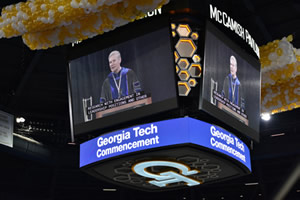
PHOTO COURTESY OF GEORGIA INSTITUTE OF TECHNOLOGY
The Georgia Institute of Technology, also known as Georgia Tech, is a top-ranked public college and one of the leading research universities in the U.S. We provide a technologically focused education to more than 25,000 undergraduate and graduate students in fields ranging from engineering, computing, and sciences, to business, design, and liberal arts.
The goal for our Department of Digital Signage Technology here at Georgia Tech is to deliver a communicative experience that results in our community feeling engaged, protected, informed, and connected. Big and broad descriptive words, yes; and all uniquely valuable, forming a guiding blueprint in terms of content decisions, screen type and location, investment models, and so on.
While each institution will have its own appetite towards limitations and opportunities in this area, the focus here at Tech is on taking digital signage to much higher levels of technological innovation—as well as higher levels of efficient service and delivery to the on-campus customer base. As costs come down barriers also come down, allowing installation of tasteful, dynamic, and centrally connected indoor and outdoor networks of screens, which is our ultimate goal.

PHOTO COURTESY OF GEORGIA INSTITUTE OF TECHNOLOGY
SIGNS OF THE TIMES. The distribution of information on a college or university campus is continuously aided and augmented by digital signage. Whether it is for events such as projecting a commencement speaker for a stadium full of attendees or informing donors of the benefits of their contributions at a reception, or everyday information sharing such as weather updates, wayfinding, dining hall menu options, parking availability, and more, advances in the design and use of digital signage are improving campus life.
What is today a somewhat connected, well-run network of 200+ screens and players located in about 50 buildings (housing colleges or departments), it can eventually grow into a massively more valuable communications platform. Plans are broad and include potential expansion into the remaining 150 +/- buildings that house departments or colleges.
The most aggressive part of the plan is to expand beyond the existing network of indoor, mounted digital screens to develop an array of exciting leading-edge new screen types and sizes to impact the entire 530-acre campus instantly and without interruption. Plans for expansion include:
- On board our fleet of buses and trolleys;
- large-scale outdoor LED in our modern building corridors;
- street furniture around campus to include dwell-time locations like bus stops, charging stations, benches, and more;
- interactive kiosks both inside and outside that offer surveillance cameras, security phones, beacons, wayfinding, and potential for facial recognition technology and beyond, as desired;
- energy dashboards and classroom schedule screens and onboard elevators;
- digital monument signage that complements the approved campus aesthetic;
- unique indoor touchscreen video walls and high-impact viewing centers;
- digital donor walls; and
- a dedicated URL for the entire network as a repository of shared content.
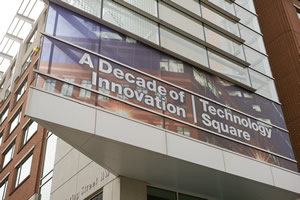
PHOTO COURTESY OF GEORGIA INSTITUTE OF TECHNOLOGY
There are many complexities to consider when contemplating a project of this scope. But to economize, the basic steps we will follow are these:
- Onboard a new content management system (CMS) that will be designed to be scalable and keep up with the many stages of our plan and the many custom content integrations necessary to the delivery of critical information/data;
- offer a new level of service delivery to our valuable customer/user base across campus to include content strategy, digital signage content creation services, SME when planning for new construction or renovation plans that involve signage;
- roll out a new plan for player connectivity that evolves around an HTML-5 platform of cloud hosting and delivery for maximum efficiency;
• deliver a master plan for revenue that leverages corporate partnerships;
- establish a new centralized form of content output that rewards both global/campus-wide and local/department interests and that presents viewers with content that delivers on the four main paths above, but also which maintains and enforces the importance of Tech’s brand standards as directed by Institute Communications; and
- create a best-in-class platform when factoring content, screens, service and delivery.
The Future Looks Bright
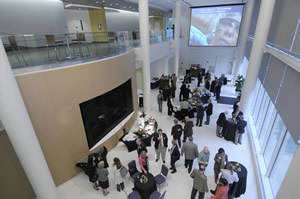
PHOTO COURTESY OF GEORGIA INSTITUTE OF TECHNOLOGY
Georgia Tech’s Atlanta campus is located in vibrant Midtown Atlanta, and our Tech Square has earned a national reputation for collaborative research between public and private entities and for globally important tech sectors like Fintech. It’s a hotbed for startup fermentation, and the list of major brands seeking to locate Innovation Centers near Tech continues to grow rapidly.
This mashup of high-tech excellence represents not only opportunity for our plan, both in terms of brand presence on the digital signage network, but also in terms of visually demonstrating the leading edge of digital delivery to those who visit Midtown or are lucky enough to live or work there. There are many amazing stories to tell and we can now have a massive new portal on which to share them.
The overall key will be inclusion: it will be critical to include in this process all departments, the student community, those charged with protecting the campus and its people, those charged with managing the flow of communication, and the leadership that directs campus on every level.
The bottom line is that while the rest of modern society is accepting and benefitting from the advantages of digital communications and signage technology, so should the campus eco-system, and many universities are embracing its controlled growth so as to coincide with strategic principles.
WHAT IS DIGITAL OUT-OF-HOME SIGNAGE?
When speaking of dynamic media installations, Digital Out-of-Home (or DOOH) refers to digital media used for marketing purposes in locations outside of the home. By definition it excludes television and radio advertising, but includes digital signage. The term “Digital Out-of-Home” is usually used in relation to advertising-based networks. The installations routinely appear in locations including, but not limited to cafés, bars, restaurants, health clubs, colleges/universities, arenas, gas stations, convenience stores, and other public spaces. DOOH can be defined by two major platforms: digital place-based networks (DPN) and digital billboards and signage (DBB).
This article originally appeared in the College Planning & Management January 2018 issue of Spaces4Learning.