Education in 2018 and Beyond: A Look Ahead
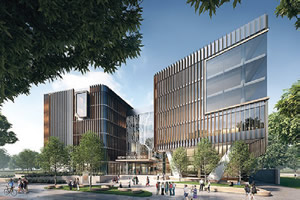 The volatility of economic, environmental, and political conditions has driven change at many levels across the world over the last 10-15 years. The planning, design, and construction of our learning environments has been subject to this “cause and effect,” responding to issues of economic fragility, increased urbanization, environmental sustainability, and brain-based and behavioral research.
There are three trends worth exploring as we consider decision making for our education systems and the learning environments we create.
URBANIZATION
The population pressures around the globe and search for employment has seen an increase in human movement to the cities. The impact is varied, from burgeoning secondary school numbers in African countries in poorly resourced and under-staffed schools, to increasing housing and workplace densities in our established western countries.
 Smart cities are driving the need for quality, sustainable living, and transport options, leading to governments and education providers to reassess the place of our schools within the urban context.
Australia, perceived as having unlimited space and low population, is a very urbanized country. Trends within each of the coastal based major cities has seen the evolution of “high-rise schools” in the inner-city areas. These are not limited to the larger cities of Melbourne and Sydney, but also extend to the planned Botanic High School in Adelaide, a STEM-focused school located as part of a larger learning and cultural precinct that includes proximity to the zoo, performing arts facilities, state library, museum, and universities. Serviced by walking paths, cycle tracks, and the public transport network, there is no provision for car parking on site. You can see more by visiting www.decd.sa.gov.au.
PROTOTYPES
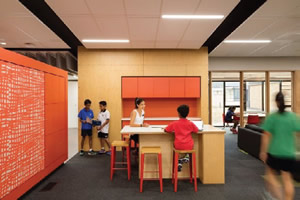
 Proliferating technological advances have driven changes to our learning and teaching practices, enabling more effective forms of pedagogy to be explored. The impact of this, from teacher-centered classrooms to more collaborative student-centered learning spaces has challenged much of our existing building stock to be adapted, refurbished, or rebuilt to keep pace. This movement has led to many things being trialed at great cost—many ideas failed as they have been trends as defined by short term fashion statements and the facilities “arms race” and not evolving out of a synergy between school cultural, strategic and educational imperatives.
The Association for Learning Environments has provided a forum for strategies and planning directions that develop thinking in a more wholistic way. The impact of this Association in Australia has been powerful. The Learning Project at Caulfield Grammar School in Melbourne, Australia, evolved out of a master planning process over the three metropolitan campuses. Identifying that most of the buildings were preventing the pedagogical shift required to see the school evolve, a process was formulated driven by evidence and research that resulted in the design and construction of a series of pre-fabricated inter-disciplinary studios to provide an enhanced user experience. The project was awarded A4LE’s highest international planning and design award in Atlanta, USA, the James D. MacConnell Award.
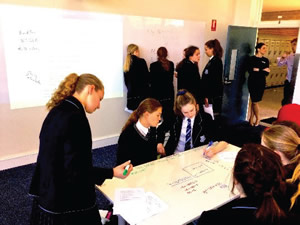 Low-cost prototyping is becoming more common as furniture providers have designed a variety of options to enable the learning environment to become an agile, responsive setting. A resourceful way of refurbishing existing rooms to test learning settings enables an evolution in practices within a school, long before resources are expended.
Developing research in the field of learning spaces is providing the intellectual rigor to support decisions made for the future. The University of Melbourne-based “Innovative Learning Environments and Teacher Change” (ILETC) project is an example of coordinating research between design and teaching faculties and exploring the effectiveness environments and practice have on the teachers and learners.
LEARNING LANDSCAPES
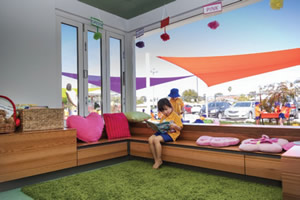
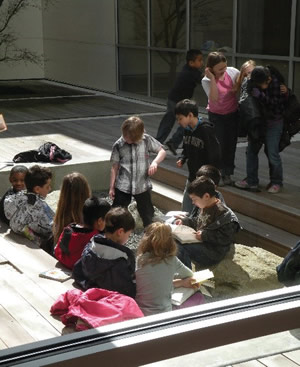 Settings for learning are becoming more wide-ranging, not limited to a traditional classroom but extending from indoors to outdoors and the seamless transition between the two. The approaches inherent in biophilic design, a practice of connecting nature with our man-made environments, enhances well-being, activates other settings for learning, and acknowledges the need to consider the whole of an educational site as a place for learning.
Ardmore Elementary School in Bellevue, Wash., provides outdoor spaces by bounding them as internal courtyards. Spaces that become activated by students provide an external setting enabling sensory experiences, and expands the learning settings beyond the physical.
The development of “nature play” settings for early learning is trending through new schools and now expanding to encompass other year levels. Connections between indoors and outdoors, enjoying natural light and ventilation, utilizing our natural world for developing “learning through play” settings will continue to flourish as our urban contexts increase in density, resources become more controlled and well being develops as an essential part of our learners’ experience.
This article originally appeared in the School Planning & Management January 2018 issue of Spaces4Learning.
About the Author
Philip Idle, ARAIA, is the director of EIW ARCHITECTS and serves as deputy chair for the Association for Learning Environments International Board.