Construction Progresses on Roux Center for the Environment at Bowdoin College

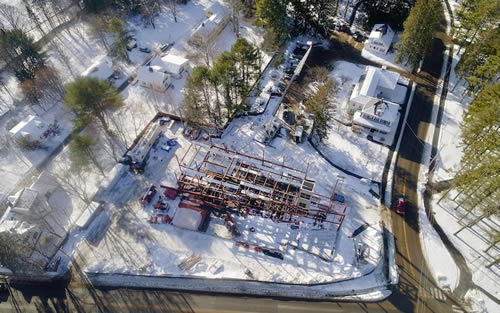
Bowdoin College's newest building—the Roux Center for the Environment—is gradually taking shape, on track to open next fall on the college's Brunswick, ME campus.

The Center, which is located at the corner of College St. and Harpswell Rd., is funded by a lead gift from David and Barbara Roux. When it is open, it will bring together faculty and students from across the College’s curriculum, fostering collaboration and creativity in the teaching and study of the environment.
Bowdoin Roux Center

Besides offices, classrooms, and labs, the 29,167 square-foot center will contain study spaces, a terrace, a green roof, and “The Lantern,” a glassed-in auditorium space at the front of the building. The building is designed to welcome all, to be a space not only for teaching and research but also for performances, community forums, social gatherings, and talks.

To date, Roux Center construction and design team—Warren Construction Group and Cambridge Seven Associates architects—have already erected steel columns and finished the elevator shaft.

The steel structure, along with corrugated metal decks, supports the concrete slab floors, which will be placed over the next couple of months. The concrete for the basement and first floor have already been placed. To work through the winter, there are heaters in the basement and the structure will be enclosed with tarps.

“The pretty stuff will start in late spring and early summer,” says Bowdoin Director of Capital Projects Don Borkowski, who is overseeing the project. “It’ll start to come together then.”

Featured

  • Florida District Completes Construction on New Leadership Institute

    Pinellas County Schools near Tampa, Fla., recently announced that construction is complete on the new Dr. Michael A. Grego Leadership Institute, according to a news release. The district partnered with Rowe Architects for the project’s design and with Skanska for construction services.

  • Designing for Every Mind

    Learning environments have the power to shape not just what students know, but who they become. When a school is designed with genuine empathy—for the full range of ways students think, sense, and engage with the world—it becomes more than a building. It becomes a catalyst for growth, confidence, and belonging. That is the animating idea behind neurodiverse design, and it is one that is transforming how more architects and designers are thinking about school design.

  • Architectural Power for the Modern Campus Landscape

    For generations, an outdoor classroom only required a textbook and a patch of grass. Today, not only has the laptop replaced the printed pages, the rise of agile learning has turned campuses into study halls with students listening to lectures and researching topics from quads, gardens, and plazas. The challenge for architects and facility managers is to provide connectivity without cluttering the landscape with visual eyesores or creating safety hazards with extension cords.

  • Moline-Coal Valley School District to Consolidate Two Schools into New Facility

    The Moline-Coal Valley School District in Moline, Ill., recently broke ground on a new elementary school that will consolidate the students and staff from two existing schools, according to local news. Robert Ontiveros Elementary School will serve as the new home for Lincoln-Irving Elementary School and Willard Elementary School.