Riverside Community College District (RCCD): RCCD Coil School of the Arts
Riverside Community College District

PHOTOS COURTESY OF LPA INC./COSTEA PHOTOGRAPHY, INC.

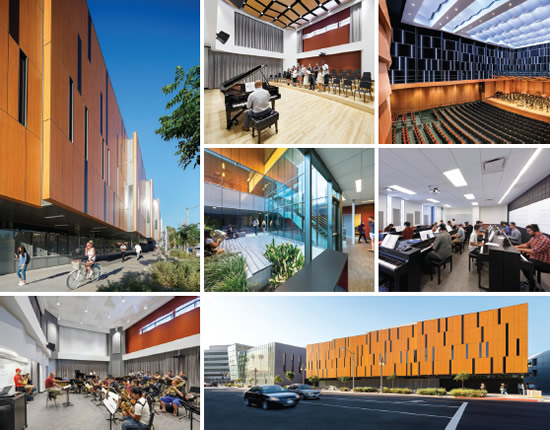
The Centennial Plaza in Riverside, CA, designed by LPA, Inc., is a project that serves a dual purpose—to provide space for instruction and to bring the community downtown to enjoy the arts. The centerpiece of the block is the LEED Gold-certified, 36,000-square-foot Coil School of the Arts. The design includes a 450-seat music concert hall, classrooms, practice rooms, a choral room, band room, orchestra room, a piano lab, and a state-of-the-art recording studio.

Designed with acoustics as a priority, the Coil School for the Arts is the home of the renowned Riverside City College Music Department. The concert hall concept design mirrors as a musical instrument, featuring deployable wall panels, mechanized perimeter drapery, and a moveable stage cloud that can be configured to support any music genre.

The architecture expresses the nature of the building, using heavy concrete masonry for its acoustical mass properties as the main building material. On the main façade, a large cantilever provides shaded spaces for outdoor visitors and users. Glass at the lower level creates a connection of the indoor activity of people in the lobby while patterned wood laminate panels resemble the craft of wood-made musical instruments.

The district’s commitment to the arts, culture, and history through the vision of the Centennial Plaza will solidify downtown Riverside’s place as an urban center for activity, creativity, and lifelong learning.

This article originally appeared in the College Planning & Management April 2018 issue of Spaces4Learning.

Featured

  • Rethinking K-12 Schools as a Continuous Learning Experience

    Most students move through three or more separate facilities during their K-12 journey, yet the built environments they encounter at each stage have traditionally been designed in isolation, with little continuity in spatial language, learning philosophy, or physical resources. Each new school is a reset with different layouts, learning models, expectations, and ways of moving through a building. The next generation of school design is making the case that the first day of kindergarten and the last day of high school can and should feel connected through common support systems and infrastructure in the physical environment.

  • Planning with Clarity: Using AI to Make Better Campus Decisions, Not Just Better Designs

    Higher education leaders are being asked to make increasingly high-stakes decisions about campus facilities amid greater uncertainty than ever before. Social and economic pressures, shifting enrollment, and evolving learning models compete with growing deferred maintenance needs to strain even the most robust infrastructure budgets.

  • Virginia Tech Tops Out New College of Engineering Building

    Virginia Tech in Blacksburg, Va., recently celebrated the topping out of Mitchell Hall, which will soon stand as the largest College of Engineering building on campus, according to a news release. The university partnered with Skanska on the 285,500-square-foot facility, which has an expected completion date of winter 2028.

  • Children walking along bright school corridor with motion blur

    How Next-Gen Design Is Reshaping the Student Experience

    The environments where students learn play a crucial role in shaping their growth in and out of the classroom. By centering design on well-being, flexibility, and purpose, districts can ensure their facilities remain vibrant community assets for many years to come.