Houston Community College Breaks Ground on Culinary Arts Center
Houston Community College

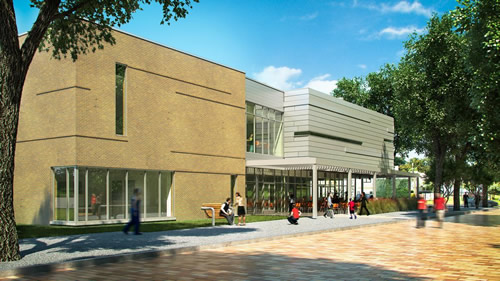
Houston Community College in Houston, TX, recently broke ground on its new Culinary Arts Center. The Center, which will be home to over 100 students each year, will contain labs for cooking and baking, a dining room, a bar, computer labs, and conference rooms with a reception area.

The new center will be two stories tall, and will be funded by a bond program approved by Houston voters in 2012. Construction on the new center is projected to take roughly two years.

Featured

  • North Carolina District Completes New Elementary School

    The Wake County Public School System (WCPSS) in Holly Springs, N.C., recently announced that construction on a new elementary school has finished, according to a news release. Rex Road Elementary School measures in at 133,000 square feet and is the fifteenth school that general contractor Balfour Beatty has completed for the district.

  • Kimball International Releases Curated Design Support Program

    Commercial furnishings company Kimball International recently announced the launch of a new end-to-end design support program, DesignSuite. According to a news release, its goal is to guide architecture & design professionals and dealer partners through the process from vision to specification.

  • California K–12 District Finishes Renovations on Multi-Sport Stadium

    The Alameda Unified School District (AUSD) in Alameda, Calif., recently announced the completion of a renovation project on the Encinal Jr. & Sr. High School stadium, according to a news release. The district partnered with Quattrocchi Kwok Architects (QKA) and Bothman Construction on the facility, and funding came from Bond Measure B.

  • Preparing for the Next Era of Healthcare Education, Innovation

    Across the country, public universities and community colleges are accelerating investments in healthcare education facilities as part of a broader strategy to address workforce shortages, modernize outdated infrastructure, and expand clinical training capacity. These projects, which are often located at the center of campus health and science districts, are no longer limited to traditional classrooms.