University of Washington Breaks Ground for Health Building

The University of Washington in Seattle, WA, recently broke ground on their new Population Health Building. The new building will create spaces that are devoted to interdisciplinary activity and research that influences the health of people around the world. The Institute for Health Metrics and Evaluation, Department of Global Health, and portions of the School of Public Health will all call the Population Health Building Home.
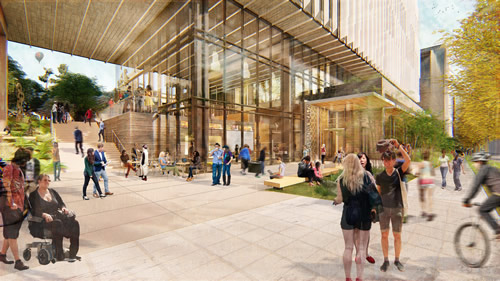
Univ of Washington Public Health

Funded by both private donations and earmarked funds, the new facility is being handled by The Miller Hull Partnership with Lease Crutcher Lewis as the general contractor. The estimated completion date for the new building is sometime in 2020.

Featured

  • Benson Polytechnic High School in Portland, OR

    Preserving Legacy, Designing for the Future

    As historic academic buildings age, institutions face a difficult decision: preserve and adapt or demolish and rebuild. How do we honor the legacy of these spaces while adapting them to meet the needs of modern learners?

  • Dallas ISD Voters Approve $6.2B Bond Package

    Dallas ISD voters have approved a record-setting $6.2-billion bond package that district leaders say will modernize aging campuses, eliminate portable classrooms and reshape learning environments across one of the nation’s largest school systems.

  • Harvard Announces Replacement Facility for Native American Program

    Harvard University in Cambridge, Mass., recently announced that construction will begin this spring on a new home for its Native American Program, according to university news. The 6,500-square-foot, all-electric building will stand three stories and serve as the central hub for the Harvard University Native American Program (HUNAP).

  • Universities Continue to Launch Multimillion-Dollar Campus Transformations

    What makes the current wave of campus development especially noteworthy is its emphasis on multi-use functionality and community integration. Institutions are no longer investing solely in academic or athletic facilities in isolation. Instead, they are creating destinations that blend recreation, health, housing, and event-driven economic activity.