University of Washington Breaks Ground for Health Building

The University of Washington in Seattle, WA, recently broke ground on their new Population Health Building. The new building will create spaces that are devoted to interdisciplinary activity and research that influences the health of people around the world. The Institute for Health Metrics and Evaluation, Department of Global Health, and portions of the School of Public Health will all call the Population Health Building Home.
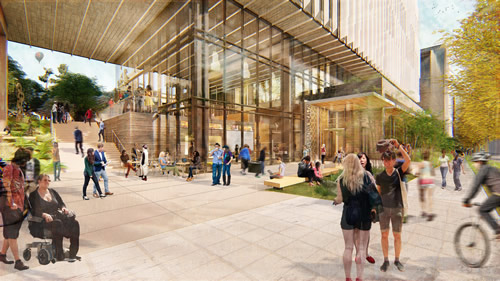
Univ of Washington Public Health

Funded by both private donations and earmarked funds, the new facility is being handled by The Miller Hull Partnership with Lease Crutcher Lewis as the general contractor. The estimated completion date for the new building is sometime in 2020.

Featured

  • abstract representation of hybrid learning environment

    The Permanence of Change: Why Hybrid Is the New Baseline

    Hybrid learning is here to stay, and it's reshaping how campus spaces function.

  • University of Rhode Island, Gilbane Partner for Three New Residence Halls

    The University of Rhode Island in Kingston, R.I., recently announced a public-private partnership with construction development firm Gilbane, according to a news release. Gilbane will soon start construction on three new residence halls with a total of 1,100 beds: two with apartment-style suites in northwest campus, and a reconstruction of the Graduate Village Apartments for graduate students.

  • UT System Board of Regents Approves $108M Housing Complex

    The University of Texas System Board of Regents recently announced the approval of a new, $108-million housing complex at the University of Texas at El Paso (UTEP), according to a news release. The facility will stand four stories and have a total of 456 new beds for freshmen students.

  • Different Starting Points, Same End Goal

    Higher education campuses can enhance student experience by implementing mobile credentials to streamline building access, on-campus payments, and access to other amenities. This enables students to connect to their campuses through the technology they use most: their mobile devices.