Construction Begins on New Jersey Elementary School

Construction began recently on the new Seaman Avenue Elementary School in Perth Amboy, N.J. The new school will be home to over 800 students in grades K-5 and will boast features such as an ESL resource room, small group study rooms, vocal and music rooms, and a computer lab.

The project, which broke ground in October 2018, will be designed by EPIC Management, Inc., along with DIGroupArchitecture, of New Brunswick, N.J. The new facility will be completed and ready to house students for the 2019-2020 academic year.
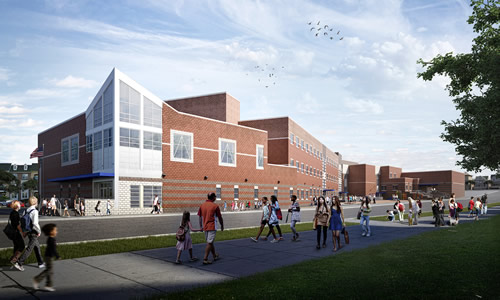
Seaman Ave Elementary School

Featured

  • Campus Safety Requires Using Every Resource Available

    Across the U.S., school and campus leaders are facing a security landscape that has changed dramatically over the past decade. Incidents on school property have increased in recent years, with several consecutive years setting record totals. According to analysis of data by CNN, dozens of shootings now occur on school grounds annually across K-12 and higher education environments.

  • Secret to Efficient, On-Time School Infrastructure & Modernization Projects is All in the Preparation

    Warmer weather and longer days make summer the ideal time for construction and modernization projects at educational facilities. School boards and construction firms must coordinate effectively to ensure that these projects do not extend even a single day into the school year and impede classroom operation.

  • RIT Saunders College of Business – Lowenthal Hall Addition

    RIT Saunders College of Business – Lowenthal Hall Addition

    Established in 1999, the Education Design Showcase is a vehicle for showing off innovative — yet practical — solutions in planning, design, architecture, and construction. RIT Saunders College of Business's Lowenthal Hall Addition has been recognized with an EDS 2026 Project of Distinction award in the category of New Construction.

  • Planning with Clarity: Using AI to Make Better Campus Decisions, Not Just Better Designs

    Higher education leaders are being asked to make increasingly high-stakes decisions about campus facilities amid greater uncertainty than ever before. Social and economic pressures, shifting enrollment, and evolving learning models compete with growing deferred maintenance needs to strain even the most robust infrastructure budgets.