KCU Breaks Ground on Center for Medical Education Innovation

The Kansas City University of Medicine and Biosciences (KCU) in Kansas City, MO, recently broke ground for the new Center for Medical Education Innovation (CMEI). The new facility will provide advanced technologies and clinical experiences for student physicians and health science professionals.
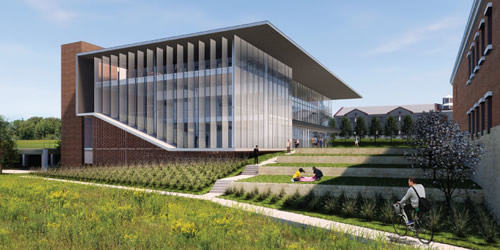
Kansas City University of Med CMEI

Consisting of four levels, the new space is being built in a way that will allow for further additions in the coming years as new medical technologies develop. Along with standard patient rooms, CMEI features areas for professional and academic research at KCU, and a host of spaces that invite and encourage collaboration between medical students and scientific researchers.

Helix Architecture and Design and CO Architects are handling the design of the building with construction responsibilities being overseen by J.E. Dunn Construction Company.

Featured

  • Indiana University Launches Capital Campus in D.C.

    Indiana University recently held a ribbon-cutting ceremony for the new IU Capital Campus in Washington, D.C., according to university news. The eight-story facility will provide a central hub for the university’s existing programs and business operations based in D.C., uniting them under one roof and providing the opportunity to expand.

  • Myrtle Grove Elementary

    Phased Construction Keeps Students on Campus During Rebuild

    When Escambia County School District needed to replace most of Myrtle Grove Elementary School in Pensacola, Fla., it had three distinct challenges: honor the school's legacy in the community, bring state-of-the-art learning environments to the county, and be seamlessly built on the same site as the active school campus.

  • nursing students talk while studying in a hallway

    Elsevier Launches VR Simulation Solution for Nursing Students

    Elsevier has introduced Shadow Health Lab with Virtual Reality, a simulation platform that allows nursing students to interact with virtual patients and build clinical judgment skills in a safe, realistic environment.

  • Q&A: How to Prevent Kitchen Grease Fires in Commercial Kitchens

    School cafeterias and university dining halls serve thousands of meals daily, relying on high-heat equipment like fryers, grills, and ovens. While these operations keep students fed, they also generate significant grease-laden vapors. Without proper controls, this grease becomes a silent fire threat. As a certified exhaust cleaning specialist and business coach who has helped hundreds of institutional facilities achieve NFPA 96 compliance, I emphasize that proactive grease management isn’t optional; it’s a core fire/life safety practice.