Funding Provided for Arts Facility at Arkansas State University

Arkansas State University in Jonesboro (ASU) recently announced that the Windgate Foundation is to offer a $6.7 million grant to build a new facility for sculpture and ceramics programs at ASU, the largest single gift to an arts program in ASU’s history.
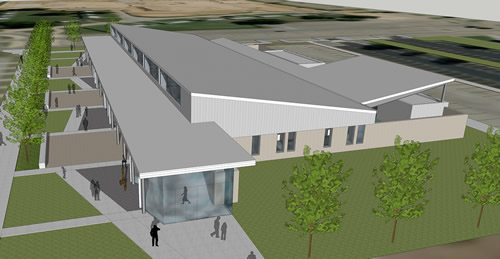
Arkansas State University Windgate Center for Three-Dimensional Arts

The proposal will fund the construction of a new facility—the Windgate Center for Three-Dimensional Arts—with studio and exhibition space for sculpture and ceramics, often referenced in the art world as the 3D arts. The new facility's studio and work areas are expected to cover approximately 20,000 square feet, almost four times the space available in ASU's Fine Arts Annex.

Featured

  • USC Launches Major AI Initiative After $200M Gift

    The University of Southern California in Los Angeles, Calif., recently announced that it has launched a “transformational” new AI initiative thanks to a $200M gift, according to a news release. The project will leverage AI toward breakthroughs and innovations in subjects like the health sciences, business, security, and the arts.

  • Stanford Online Reveals New Immersive Learning Studio

    Stanford Online recently marked its 30th anniversary with the announcement of a new immersive learning studio, according to a university news release. The studio takes advantage of AI-powered and immersive learning technologies to continue delivering personalized and faculty-led education.

  • Higher Ed is Betting on New Buildings While Quietly Undermining Their Campuses — Here’s Why

    In this climate, the owner’s representative has changed from a delivery-focused advisor to a strategic campus partner. Institutions are increasingly relying on owner’s reps not just to manage, cope, schedule, and budget, but also help evaluate whether a project should proceed at all.

  • abstract illustration of school gym

    How the Gymnasium Can Serve as a Model for Learning Space Design

    Multipurpose gyms work because flexibility was built into the brief from the start, not retrofitted later. The same logic applies to academic spaces.