District Goes Cordless for Speed and Safety
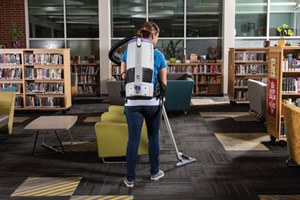
Blue Valley School District was able to eliminate cordrelated safety hazards, increase environmental cleanliness and cut cleaning time nearly in half with ProTeam cordless backpack vacuums.
“It’s just like the name, GoFree; you can go anywhere with it,” says Matthew Brooks, custodial coordinator for Blue Valley School District, one of the major school districts in the Kansas City Metropolitan Area. The district recently implemented the ProTeam GoFree Flex Pro cordless backpack vacuum to reduce vacuuming time and improve safety.
The district’s 50-plus facilities span 4.4 million square feet of space. Some of the older buildings have limited outlets making it difficult for Brooks’ staff to vacuum the buildings, and he found custodians taking risks to get the job done.
When a custodian cleans with the Go-Free Flex Pro cordless backpack vacuum, cord-related risks are eliminated and cleaning is significantly faster.
Vacuuming used to take three hours for 18 to 20 classrooms, including hallways. The cordless backpack vacuum reduced that to two hours. Since the staff has been using the GoFree, the time-savings is approaching 40 percent.
The time saved from using cordless backpack vacuums has gone to dusting, spot cleaning carpets and sanitizing desktops daily rather than every other day. The custodians also switched from rags to backpack vacuums for dusting. According to Brooks, backpacks are more effective at capturing dust.
The reallocation of time to improve cleaning has had measurable results. One school was hovering around a 2.5 on the APPA scale (one is the highest standard of cleanliness and five is the lowest). Implementing the cordless backpack vacuums improved the school’s score to 2.0.
“If you’re not maintaining your building so your students have a safe and clean environment, it hurts their ability to learn,” says Brooks.
proteam.emerson.com
This article originally appeared in the School Planning & Management October 2018 issue of Spaces4Learning.