Keck Center for Science and Engineering Opens at Chapman University

The Keck Center for Science and Engineering on the campus of Chapman University in Orange, CA, opened its doors to students and faculty in August, just in time for the new academic year. Supported by a $20 million grant from W.M. Keck Foundation, this game-changing facility spans nearly an entire city block and offers 140,000 square feet of space for learning, research, and collaboration. Home to Schmid College of Science and Technology, the building will also house Dale E. ’58 and Sarah Ann Fowler School of Engineering, opening in fall 2020.
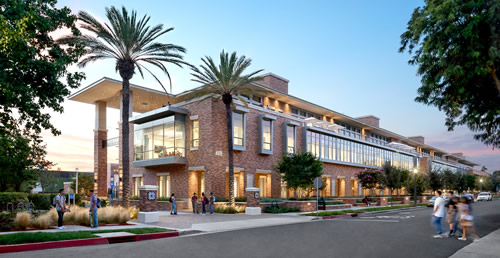
KECK

The Keck Center is comprised of three floors and divided into two sections: the Hall of Science and the Hall of Technology and Engineering, bridged by a grand arch that serves as the focal point of the building. In total, the center includes 18 teaching labs, 22 research labs, 47 faculty and graduate student offices, three multipurpose classrooms, and six collaboration areas for students and faculty. The facility also features an 833-seat outdoor amphitheater/stadium and a 347-space, two-story subterranean parking garage.

To enhance interdisciplinary work, the Keck Center features high-tech equipment and design elements such as writable glass walls within the science, technology, and engineering labs.

Featured

  • Vanderbilt to Partner with ABM for Campus Preservation and Modernization

    Vanderbilt University recently announced that it has selected ABM Performance Solutions for a preservation and modernization project at its New York City campus, according to a news release. ABM will deliver its end-to-end ABM Performance Solutions (APS) model to manage critical operations during renovation and maintenance.

  • Miami University Approves New $242M Multipurpose Arena

    Miami University in Oxford, Ohio, recently announced that its Board of Trustees has approved construction of a new multipurpose arena at Cook Field, according to university news. The $242-million project will serve as a new centralized hub for student life and create space for economic development on campus.

  • Pitzer College

    Designing for Change in Higher Ed Learning Environments

    Higher education will continue to evolve, and learning environments must evolve with it. By prioritizing adaptable infrastructure, thoughtful reuse, strong energy performance, and wellness-centered design, campuses can create spaces that support learning today while remaining flexible for the future.

  • Harvard Announces Replacement Facility for Native American Program

    Harvard University in Cambridge, Mass., recently announced that construction will begin this spring on a new home for its Native American Program, according to university news. The 6,500-square-foot, all-electric building will stand three stories and serve as the central hub for the Harvard University Native American Program (HUNAP).