Texas Woman’s University Breaks Ground on Science and Research Center

Texas Woman's University (TWU) in Denton, TX, broke ground this month on a new science and research center that will add critical research space and enhance efforts to increase research activities at the institution.
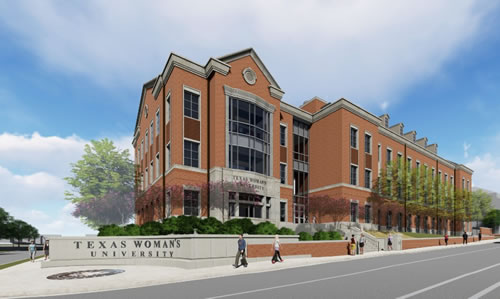
Texas Womans University Science and Research Center

The four-story, 80,000-square-foot building will house graduate and undergraduate research laboratory space for Biology, Chemistry and Biochemistry, Nutrition & Food Science, and Psychology programs. Additionally, the building will include collaboration and conference spaces as well as faculty offices, graduate student workspaces, lab support spaces, scientific equipment repair services and a microscopy suite.

The building's exterior design will incorporate Georgian architecture to complement the historical elements of other TWU buildings and the interior will include modern touches to suit the research center's scientific function. Full-height glass walls will be used in all spaces so occupants can see into and from all areas of the building.

The building is scheduled for completion in June 2020. Total project cost is estimated to be $54 million.

Featured

  • Harvard Announces Replacement Facility for Native American Program

    Harvard University in Cambridge, Mass., recently announced that construction will begin this spring on a new home for its Native American Program, according to university news. The 6,500-square-foot, all-electric building will stand three stories and serve as the central hub for the Harvard University Native American Program (HUNAP).

  • Campus Safety Requires Using Every Resource Available

    Across the U.S., school and campus leaders are facing a security landscape that has changed dramatically over the past decade. Incidents on school property have increased in recent years, with several consecutive years setting record totals. According to analysis of data by CNN, dozens of shootings now occur on school grounds annually across K-12 and higher education environments.

  • Designing Third Spaces That Do What AI Can't

    In 2026, education is evolving faster than ever. With AI reshaping everything from lesson planning to personalized instruction, schools and universities are turning their attention to what AI can’t replicate: spaces that foster collaboration, community, and creativity.

  • Universities Continue to Launch Multimillion-Dollar Campus Transformations

    What makes the current wave of campus development especially noteworthy is its emphasis on multi-use functionality and community integration. Institutions are no longer investing solely in academic or athletic facilities in isolation. Instead, they are creating destinations that blend recreation, health, housing, and event-driven economic activity.