Texas Woman’s University Breaks Ground on Science and Research Center

Texas Woman's University (TWU) in Denton, TX, broke ground this month on a new science and research center that will add critical research space and enhance efforts to increase research activities at the institution.
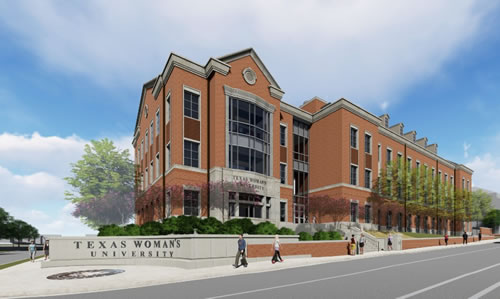
Texas Womans University Science and Research Center

The four-story, 80,000-square-foot building will house graduate and undergraduate research laboratory space for Biology, Chemistry and Biochemistry, Nutrition & Food Science, and Psychology programs. Additionally, the building will include collaboration and conference spaces as well as faculty offices, graduate student workspaces, lab support spaces, scientific equipment repair services and a microscopy suite.

The building's exterior design will incorporate Georgian architecture to complement the historical elements of other TWU buildings and the interior will include modern touches to suit the research center's scientific function. Full-height glass walls will be used in all spaces so occupants can see into and from all areas of the building.

The building is scheduled for completion in June 2020. Total project cost is estimated to be $54 million.

Featured

  • Full Sail University Announces First Student Housing Facility

    Full Sail University in Winter Park, Fla., recently announced that development has begun on its first student housing community, according to a news release. The university is partnering with Nvision Development for construction and long-term management of the facility, which will stand five stories and have the capacity for more than 570 beds.

  • Arizona District Breaks Ground on Community Training, Learning Center

    The Tolleson Union High School District (TUHSD) in Tolleson, Ariz., recently broke ground on a new Training & Learning Center (TLC) for both district professionals and the community at large, according to a news release. The 90,000-square-foot facility has an estimated completion date of spring 2027.

  • Pitzer College

    Designing for Change in Higher Ed Learning Environments

    Higher education will continue to evolve, and learning environments must evolve with it. By prioritizing adaptable infrastructure, thoughtful reuse, strong energy performance, and wellness-centered design, campuses can create spaces that support learning today while remaining flexible for the future.

  • Surging Demand for Student Housing Fuels Major Campus Investment Opportunities

    University leaders throughout the U.S. are accelerating plans to modernize and expand student housing as enrollment stabilizes and demand for on-campus living rebounds. Recent data from the National Center for Education Statistics indicates that total postsecondary enrollment is projected to grow through the end of the decade, with undergraduate enrollment alone expected to increase by more than 8 percent by 2030.