Virginia Commonwealth University to Build New $121M STEM Education Facility

RICHMOND, VA – The Virginia state budget recently signed by Gov. Ralph Northam includes funding for Virginia Commonwealth University to construct a $121-million, 168,000-square-foot, six-floor building dedicated to science, technology, engineering, and math education on the Monroe Park Campus.
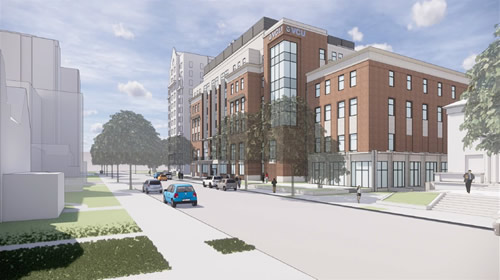
Virginia Commonwealth University STEM building

The building will house lab, classroom, and office space for the College of Humanities and Sciences and will expand existing lab space, facilitate innovative and flexible teaching methods, provide students with instructional and study spaces, and free up space in other College of Humanities and Sciences buildings to better serve students and faculty.

It will include 34 teaching labs; the Math Exchange, an innovative facility for math instruction; a Science Learning Center; two large-capacity classrooms; computer labs; and large- and small-capacity flexible classrooms. It will feature instructional wet and dry labs and classrooms for teaching chemistry, biology, physics, math, psychology, and kinesiology.

The building will be designed by Ballinger and Quinn Evans Architects and constructed by Hourigan.

Featured

  • Architectural Power for the Modern Campus Landscape

    For generations, an outdoor classroom only required a textbook and a patch of grass. Today, not only has the laptop replaced the printed pages, the rise of agile learning has turned campuses into study halls with students listening to lectures and researching topics from quads, gardens, and plazas. The challenge for architects and facility managers is to provide connectivity without cluttering the landscape with visual eyesores or creating safety hazards with extension cords.

  • Compton High School

    Compton High School

    Established in 1999, the Education Design Showcase is a vehicle for showing off innovative — yet practical — solutions in planning, design, architecture, and construction. Compton High School has been recognized with an EDS 2026 Project of Distinction award in the category of New Construction.

  • A digital silhouette works at a computer, immersed in a glowing, interconnected world

    How Will AI Transform Learning Space Design?

    For years, higher education has designed learning spaces around technology as a tool for display, capture, collaboration, and connectivity. AI changes that equation.

  • Designing Third Spaces That Do What AI Can't

    In 2026, education is evolving faster than ever. With AI reshaping everything from lesson planning to personalized instruction, schools and universities are turning their attention to what AI can’t replicate: spaces that foster collaboration, community, and creativity.