Texas A&M AgriLife Unveils Plans For A Robotic Greenhouse Facility

COLLEGE STATION, TX – Texas A&M University’s Texas A&M AgriLife unveiled plans in May for a multi-million-dollar Automated Precision Phenotyping Greenhouse that will utilize advanced sensor technology to enhance agricultural crops in the areas of crop health, yield, nutrition, temperature, drought stress, and other environmental conditions.
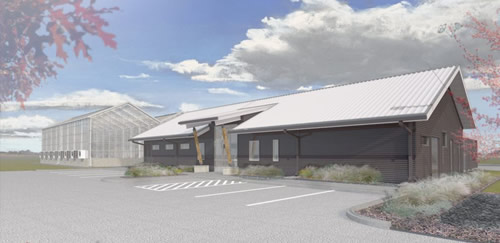
Texas Agrilife Greenhouse

The project, expected for completion by summer 2020, is being led by AgriLife Research and the College of Agriculture and Life Sciences. Both AgriLife Research scientists and faculty will use the facility for experimental trials as well as a teaching platform for undergraduate and graduate students.

Two 2,400-square-foot greenhouses for physicists, biochemists, and engineers will work alongside a 3,813-square-foot headhouse with field scientists working in soil, plant, microbe, insect, and other disciplines.

The facility is funded by the Chancellor’s Research Initiative Award and matched by the Governor’s University Research Initiative Award. Additional robotic equipment is funded by a Research Development Fund Award. The facility has a construction budget estimated at $3.5 million.

Featured

  • Arlington High School

    Arlington High School

    Established in 1999, the Education Design Showcase is a vehicle for showing off innovative — yet practical — solutions in planning, design, architecture, and construction. Arlington High School has been recognized with an EDS 2026 Grand Prize award in the category of New Construction.

  • Texas Recruitment

    Texas Recruitment

    Established in 1999, the Education Design Showcase is a vehicle for showing off innovative — yet practical — solutions in planning, design, architecture, and construction. The University of Texas at Austin's Texas Recruitment has been recognized with an EDS 2026 Grand Prize award in the category of Renovation.

  • Higher Ed is Betting on New Buildings While Quietly Undermining Their Campuses — Here’s Why

    In this climate, the owner’s representative has changed from a delivery-focused advisor to a strategic campus partner. Institutions are increasingly relying on owner’s reps not just to manage, cope, schedule, and budget, but also help evaluate whether a project should proceed at all.

  • Designing for Every Mind

    Learning environments have the power to shape not just what students know, but who they become. When a school is designed with genuine empathy—for the full range of ways students think, sense, and engage with the world—it becomes more than a building. It becomes a catalyst for growth, confidence, and belonging. That is the animating idea behind neurodiverse design, and it is one that is transforming how more architects and designers are thinking about school design.