Texas A&M AgriLife Unveils Plans For A Robotic Greenhouse Facility

COLLEGE STATION, TX – Texas A&M University’s Texas A&M AgriLife unveiled plans in May for a multi-million-dollar Automated Precision Phenotyping Greenhouse that will utilize advanced sensor technology to enhance agricultural crops in the areas of crop health, yield, nutrition, temperature, drought stress, and other environmental conditions.
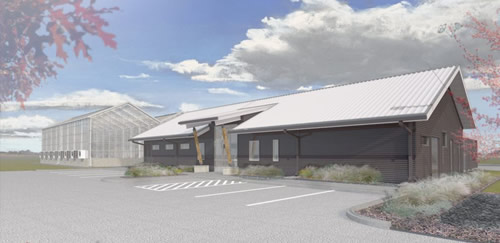
Texas Agrilife Greenhouse

The project, expected for completion by summer 2020, is being led by AgriLife Research and the College of Agriculture and Life Sciences. Both AgriLife Research scientists and faculty will use the facility for experimental trials as well as a teaching platform for undergraduate and graduate students.

Two 2,400-square-foot greenhouses for physicists, biochemists, and engineers will work alongside a 3,813-square-foot headhouse with field scientists working in soil, plant, microbe, insect, and other disciplines.

The facility is funded by the Chancellor’s Research Initiative Award and matched by the Governor’s University Research Initiative Award. Additional robotic equipment is funded by a Research Development Fund Award. The facility has a construction budget estimated at $3.5 million.

Featured

  • Rethinking K-12 Schools as a Continuous Learning Experience

    Most students move through three or more separate facilities during their K-12 journey, yet the built environments they encounter at each stage have traditionally been designed in isolation, with little continuity in spatial language, learning philosophy, or physical resources. Each new school is a reset with different layouts, learning models, expectations, and ways of moving through a building. The next generation of school design is making the case that the first day of kindergarten and the last day of high school can and should feel connected through common support systems and infrastructure in the physical environment.

  • Planning with Clarity: Using AI to Make Better Campus Decisions, Not Just Better Designs

    Higher education leaders are being asked to make increasingly high-stakes decisions about campus facilities amid greater uncertainty than ever before. Social and economic pressures, shifting enrollment, and evolving learning models compete with growing deferred maintenance needs to strain even the most robust infrastructure budgets.

  • Virginia Tech Tops Out New College of Engineering Building

    Virginia Tech in Blacksburg, Va., recently celebrated the topping out of Mitchell Hall, which will soon stand as the largest College of Engineering building on campus, according to a news release. The university partnered with Skanska on the 285,500-square-foot facility, which has an expected completion date of winter 2028.

  • Children walking along bright school corridor with motion blur

    How Next-Gen Design Is Reshaping the Student Experience

    The environments where students learn play a crucial role in shaping their growth in and out of the classroom. By centering design on well-being, flexibility, and purpose, districts can ensure their facilities remain vibrant community assets for many years to come.