Berry College Renovates Historic Ford Auditorium

ROME, GA – High-performance acoustics, digital lighting and sound systems, and reconfigured audience seating are among enhancements underway as JE Dunn Construction renovates and restores historic Ford Auditorium on the campus of Berry College in Rome, GA.

The renovation—funded by gifts from more than 400 alumni and friends—will enhance the experiences of artists and audience members alike, delivering benefits from improved sightlines to impressive multimedia capabilities, while preserving and restoring historic elements of the facility, which dates to the late 1920s.

Ford Auditorium is Berry’s signature venue for music performance. It also provides rehearsal and classroom spaces for the college’s music program. It is part of a group of campus buildings known as the Ford Complex, named after Ford Motor Company founder Henry Ford, who along with his wife, Clara, were generous supporters in the earliest days of the school. These impressive English Gothic structures were featured on a recent USA Today list of 51 amazing university and college buildings.
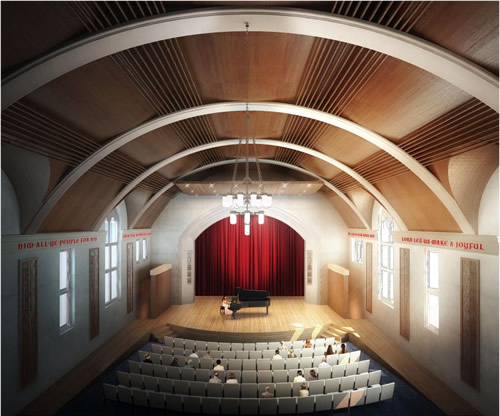
Berry College Ford Auditorium

Improvements to the iconic auditorium will also include repairing the building’s leaded stained glass cathedral windows, enlarging the stage and upgrading curtain systems, new seating, reestablishing the plaster arches, refurbishing the lobby and restrooms, revamping MEP systems, and installing a new oak tongue-and-groove radiused ceiling.

The project’s architect of record is Cevian Design Lab. Kirkegaard Associates of Chicago is providing acoustics consulting.

The auditorium will be completed in time for start of spring semester January 2020.

Featured

  • Montclair State University Starts Construction on $120M STEM Building

    Montclair State University in Montclair, N.J., recently broke ground on a new $120-million Interdisciplinary Science Building, according to university news. The university partnered with HoK Architects for the project’s design, and it’s scheduled to open in time for the 2028–29 academic year.

  • Classical building columns display digital data streams

    The Campus Nervous System: Why Facilities Risk Is Now a Leadership Issue in Higher Education

    Facility performance now intersects with safety, compliance, on-campus experience, institutional reputation, and financial resilience. That places it firmly on the leadership agenda.

  • Q&A: How to Prevent Kitchen Grease Fires in Commercial Kitchens

    School cafeterias and university dining halls serve thousands of meals daily, relying on high-heat equipment like fryers, grills, and ovens. While these operations keep students fed, they also generate significant grease-laden vapors. Without proper controls, this grease becomes a silent fire threat. As a certified exhaust cleaning specialist and business coach who has helped hundreds of institutional facilities achieve NFPA 96 compliance, I emphasize that proactive grease management isn’t optional; it’s a core fire/life safety practice.

  • UT-San Antonio Begins Residence Hall Renovations

    The University of Texas at San Antonio recently began a $6-million renovation project to one of its residence halls, according to a news release. Originally completed in 1986, Chisolm Hall measures in at 120,860 square feet and is the oldest and largest residence hall on campus.