Wofford College Building Environmental Studies Center

SPARTANBURG, SC – Wofford College has broken ground on its new environmental studies center that will be Green Globe-certified for its sustainable and environmentally conscious features, such as a partial green roof and solar roof panels. Green Globe certification is a structured assessment of the sustainability performance of the facility.
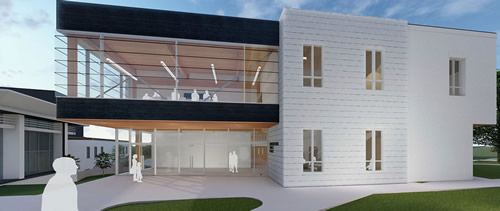
Wofford College Environmental Buidling

The 20,000-square-foot facility will feature advanced laboratory space, a seminar room, outdoor patio and garden spaces, and classroom and office space for Wofford’s Department of Environmental Studies as well as the other sciences.

The building also will include a system for capturing rainwater for irrigation and will use cross-laminated timbers, which are made of sustainable, all-wood construction.

Featured

  • Arlington High School

    Arlington High School

    Established in 1999, the Education Design Showcase is a vehicle for showing off innovative — yet practical — solutions in planning, design, architecture, and construction. Arlington High School has been recognized with an EDS 2026 Grand Prize award in the category of New Construction.

  • Texas Recruitment

    Texas Recruitment

    Established in 1999, the Education Design Showcase is a vehicle for showing off innovative — yet practical — solutions in planning, design, architecture, and construction. The University of Texas at Austin's Texas Recruitment has been recognized with an EDS 2026 Grand Prize award in the category of Renovation.

  • Higher Ed is Betting on New Buildings While Quietly Undermining Their Campuses — Here’s Why

    In this climate, the owner’s representative has changed from a delivery-focused advisor to a strategic campus partner. Institutions are increasingly relying on owner’s reps not just to manage, cope, schedule, and budget, but also help evaluate whether a project should proceed at all.

  • Designing for Every Mind

    Learning environments have the power to shape not just what students know, but who they become. When a school is designed with genuine empathy—for the full range of ways students think, sense, and engage with the world—it becomes more than a building. It becomes a catalyst for growth, confidence, and belonging. That is the animating idea behind neurodiverse design, and it is one that is transforming how more architects and designers are thinking about school design.