Floor Raceway System Wrangles Wayward Wires

A company that makes hardware for managing tech infrastructure has released a new solution for organizing messy cables and wires. The "Smart-Way On-Floor Raceway System" from FSR installs on top of flooring to take the place of having to build a subfloor to accommodate wiring.
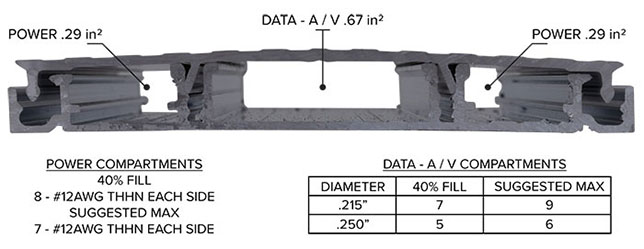
It's sold in 6-foot sections and provides three separate compartments in its track: two for power lines and another for data and AV lines. The design includes centering V-grooves in the track to help locate pilot/clearance holes for securing fasteners.

The Smart-Way is a half-inch high, ADA compliant and available in slate-gray or aluminum finishes. It's sold in 6-foot sections and provides three separate compartments in its track: two for power lines and another for data and AV lines. The design includes centering V-grooves in the track to help locate pilot/clearance holes for securing fasteners. An elbow kit enables the installer to make 45 or 90-degree angles that minimize the bend radius of wire.
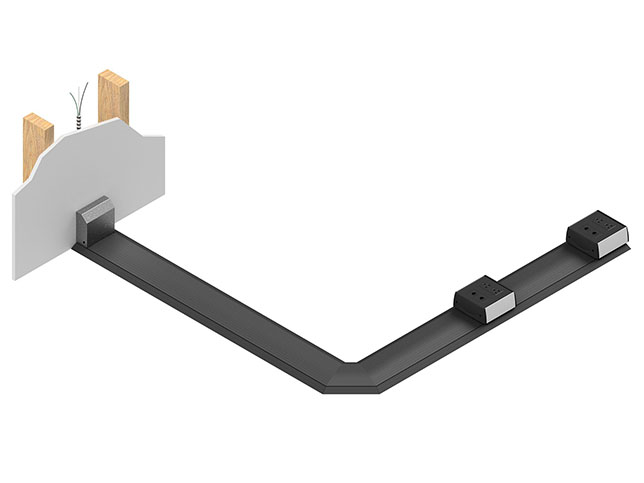
An elbow kit enables the installer to make 45 or 90-degree angles that minimize the bend radius of wire.

Suggested pricing is set at $230 for each segment and $125 for corners.

"It's a very small, unobtrusive bump in the floor," said Chaz Porter, the company's sales director, in a video about the product.

The system is expected to begin shipping in mid-August.

About the Author

Dian Schaffhauser is a former senior contributing editor for 1105 Media's education publications THE Journal, Campus Technology and Spaces4Learning.

Featured

  • Nashville Elementary School Receives LEED Gold Certification

    Goodlettsville Elementary School, part of Metro Nashville Public Schools in Nashville, Tenn., recently achieved LEED Gold Certification from the U.S. Green Building Council (USGBC), according to a news release. The 81,750-square-foot school opened in 2023 and was designed by Goodwyn Mills Cawood (GMC).

  • Building Beyond Simulation: Creating Immersive Ecosystems for Healthcare Education

    Health sciences education is one of the fastest-growing facility types in colleges and universities. The demand for medical, nursing, and allied health professionals is driving the creation and renovation of medical simulation training facilities that provide students with real-world experience through advanced simulation-based learning.

  • Planning with Clarity: Using AI to Make Better Campus Decisions, Not Just Better Designs

    Higher education leaders are being asked to make increasingly high-stakes decisions about campus facilities amid greater uncertainty than ever before. Social and economic pressures, shifting enrollment, and evolving learning models compete with growing deferred maintenance needs to strain even the most robust infrastructure budgets.

  • University of Pennsylvania Releases Design of Future Physical Sciences Building

    The University of Pennsylvania (Penn) in Philadelphia, Penn., recently released renderings of an upcoming 350,000-square-foot Physical Sciences Building, according to news release. The facility was designed by CO Architects and will unite the university’s departments of Physics and Astronomy, Mathematics, and Earth and Environmental Science.