Pollinator-Friendly Solar
Denison University, a private liberal arts
university in Granville, OH, strives to be an exemplary
steward of the natural world and a leader in sustainability.
Denison takes an intentionally multidisciplinary approach to
sustainability that balances environmental, economic, and social
responsibility.
A Solar Commitment
Clean, renewable solar energy is a growing part of Denison’s
commitment to sustainability. That commitment began in the
1960s with the foundation of the Biological Reserve, a 350-acre
parcel set aside for student and faculty research as well as enjoyment
by the community. It continued with the establishment of the
Homestead in the 1970s. An alternative student living arrangement,
off the energy grid, the Homestead is one of the first such
communities in the country and is still going strong today.
In addition to three rooftop solar arrays on campus,
Denison’s newest solar array, activated in December 2017, was
established to generate 2.3 MW of power, about 10 percent of
the college’s energy use. For this installation, Denison provided
about 10 acres of “compromised” land from which the top soil
had been removed for other uses and scrub trees and nonnative
plants had filled the void.
Today, that land is a pollinator-friendly solar habitat.
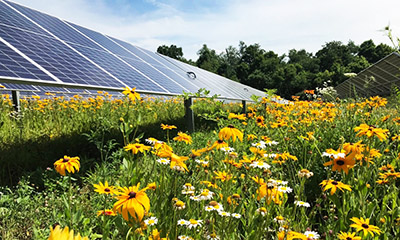
Denison’s pollinator-friendly solar array is the first of its kind
in Ohio and the first in a five-state area, demonstrating an innovative
and productive use for the land under and around groundmounted
solar panels.
Denison’s ground-mounted solar array has a generation capacity
of 2.3 MW solar array and produces 2,800,000 kWh annually. It
is home to more than 1,000,000 flowering and pollinator-friendly
plants. Only in its first year, the pollinator habitat already is
teeming with butterflies, bees, and other beneficial insects. They,
in turn, are attracting and supporting birdlife in the adjacent 350-acre Biological Reserve.
A Team Project
“So many people from all different interests came together
to build this project,” says Jeremy King, Denison’s sustainability
coordinator. Key partners in the project include Pheasants Forever,
AEP Energy, U.S. Fish and Wildlife, Third Sun Solar, and the
Center for Pollinators in Energy at Fresh Energy. “It was heartening
to see how a pollinator habitat could become a common goal
for everyone.”
King also will join the advisory committee to a 25-site study
over 10 states being led by the National Renewable Energy Laboratory
to examine best practices in vegetation establishment and
management on solar arrays. Preliminary results of the study,
named InSPIRE, indicate that establishing a low-growing meadow,
rather than using gravel or turfgrass, leads to reduced operations
costs and can influence panel efficiency by creating a cooler microclimate
under the panels.
“Denison University’s leadership reveals a simple fact—when
buyers specifically ask for energy from a pollinator-friendly solar
array, the resulting partnerships and landscape are beautiful,”
says Rob Davis, co-chair of the InSPIRE study advisory committee
and director of the Center for Pollinators in Energy at nonprofit
Fresh Energy.
“We applaud Denison University’s leadership and landscape
stewardship and hope to see it become a standard practice for
large-scale solar throughout the region,” said Michael Retterer,
state coordinator for Ohio Pollinator Habitat Initiative and Pheasants
Forever.
Exceeding Expectations
The 10-acre solar array significantly exceeds the beneficial
habitat threshold established by Ohio Pollinator Habitat Initiative,
a consortium of more than 80 organizations including
representatives from government agencies and conservation
organizations.
Some fun facts about the Denison Pollinator Habitat:
- Native bees, monarch butterflies, and grassland birds populate
the habitat.
- Plants include Golden Alexander, Showy Black-eyed Susan,
Mountain Mint, and Heath Aster.
- The site provides habitat equivalent to more than 6,000 homes
each planting 6-foot-by-12-foot pollinator gardens and then
maintaining them for 30 years.
- The Solar Site Pollinator Habitat Planning and Assessment
Scorecard, published by the Ohio Pollinator Habitat Initiative,
establishes a standard for pollinator-friendly solar.
- The deep-rooted native plants are better at stormwater and soil
retention and more resilient to new weather patterns.
- Mowing only once per year cuts down on energy use.
- Thicker vegetation under solar panels creates a cooler microclimate.
Panels can run more efficiently, providing peak performance
and extending longevity of the panels.
- The site is managed to be free of noxious/invasive weeds.
This article originally appeared in the College Planning & Management September 2019 issue of Spaces4Learning.