Gemini Middle School Reveal New Changes, Continues Construction

Gemini Middle School, outside of Chicago, debuted several changes as they began this school year. Formerly known as Gemini Junior High, the school unveiled new renovations as they welcomed their doors to more than 1,000 students from 6th to 8th grade.
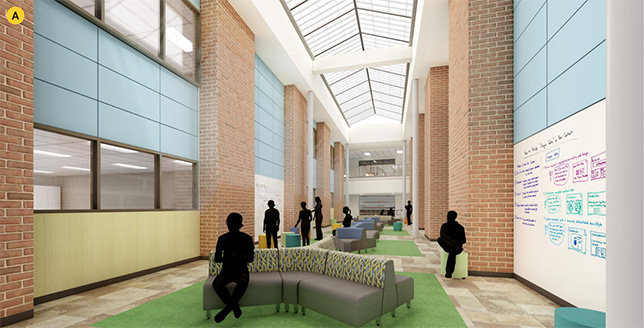
The new student commons at Gemini Middle School is filled with natural light.

The expansion and remodeling cost $33 million and is expected to be fully completed by the end of the year. The middle school renovations were designed by DLA Architects.

“We’re really excited about the new spaces that we have created that are going to provide fun, exciting and collaborative learning opportunities for students,” Principal Lewis Roberts told the Chicago Tribune.

“We’ve also spent a lot of time thinking about how students learn...the 21st century learner, and what students are going to need to prepare them not only for high school, but for life skills.”
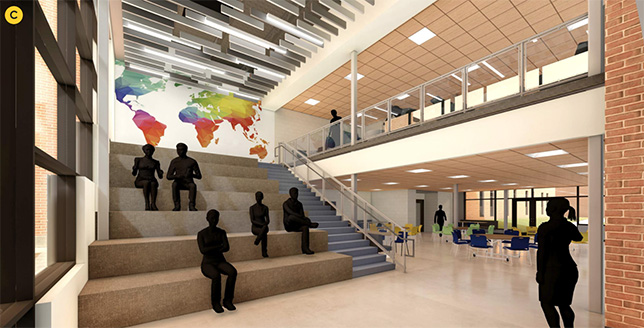
Gemini Middle School, outside of Chicago, debuted several changes as they began this school year including an expanded cafeteria with learning stairs.

Features of the school include:

  • A new fitness center;
  • An expanded cafeteria with learning stairs;
  • An instrumental music suite;
  • An interior courtyard;
  • An auxiliary multi-purpose room with a stage; and
  • Kitchens for home economics.

The entrance will have the school mascot, along with blue and gold school colors, on the windows. The new student commons is filled with natural light. There are more writable surfaces located throughout the school to encourage expression and learning. In addition, there are numerous plugs to charge student-issued Chromebooks.

Upgrades to the middle school began when East Maine School District 63’s launched their master plan in December 2016. More than 100,000 square feet of space was part of the upgrades.


About the Author

Yvonne Marquez is senior editor of Spaces4Learning. She can be reached at [email protected].

Featured

  • Spaces4Learning Trends & Predictions for Educational Facilities in 2026: Part II

    As education leaders look toward 2026, the design of K–12 and higher education facilities is being reshaped by powerful, converging forces. Survey respondents point to the rapid growth of Career and Technical Education, deeper alignment with workforce and industry needs, and the accelerating influence of AI and emerging technologies.

  • iPark 87

    Building a Future-Focused Career and Technical Education Center

    A district superintendent shares his team's journey to aligning student passions with workforce demands, and why their new CTE center could be a model for districts nationwide.

  • UNL Kiewit Hall

    Designing for Engineering Excellence: Integrating Sustainability and Wellness at UNLs Kiewit Hall

    Kiewit Hall at the University of Nebraska-Lincoln exemplifies how academic institutions can integrate sustainability and wellness into modern learning environments. With an integrated and collaborative team approach, Kiewit Hall addresses enhanced learning and creativity, physical health, and mental wellness, and fosters a sense of community through innovative design, operations, and policy solutions.

  • Massachusetts K–12 District Selects Architect for New Junior High

    Swansea Public Schools in Swansea, Mass., recently announced that it has selected Finegold Alexander Architects to design a new junior high school for the district, according to a news release. The firm will create the Feasibility Study and Schematic Design for Joseph Case Junior High School after a lengthy selection process by the Massachusetts School Building Authority (MSBA).

Digital Edition