Kenyon College Building New Library

GAMBIER, OH – September 10 marked an occasion to celebrate in the construction of the new library at Kenyon College, designed by GUND Partnership. The entire campus community and design and construction teams were invited to sign a structural steel beam painted Kenyon’s signature purple. The beam signing was followed with a ceremony to mark the topping off of the library. Kenyon President Sean Decatur officiated the ceremony and unveiled the building’s new name, a name that is borrowed from the past: Chalmers Library. After the name was announced, spectators watched as Smoot Construction hoisted the purple beam to the top of the new library. Construction will be complete by the end of 2020, with an opening planned for spring 2021.
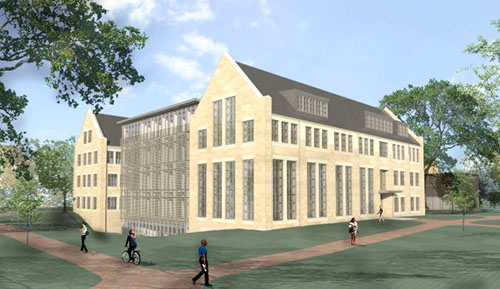
Kenyon College Library 500

Chalmers Library replaces Kenyon’s existing Olin and Chalmers libraries, which were not optimized for 21st-century learning and were at their physical limits. The new library is expecting LEED Gold certification and presents one of the largest opportunities to reduce Kenyon’s carbon footprint through signification energy savings. The new highly flexible state-of-the-art library will support active and collaborative learning and will feature a variety of environments to encourage student growth, curiosity, and exploration. Academic Advising, Career Development, the Registrar, and Student Accessibility Services will move to the library as an integrated hub connecting work inside the classroom with work outside of it.

The original Chalmers Memorial Library opened in 1962 and was named for Gordon Keith Chalmers, Kenyon’s 13th president, who served from 1937 until his death in 1956. The new Chalmers library will also recognize his wife, Roberta Teale Swartz Chalmers H’60, a poet, teacher, and co-founder of the Kenyon Review.

Featured

  • Can AI Help Build Stronger Communities in Student Housing?

    Student housing success is shifting from operational performance to student experience, with belonging now at the center. A recent 2025 report underscores a growing emphasis on student well-being, community, and engagement, signaling that expectations now extend beyond logistics to ensure students feel supported in their living environments. AI is enabling that shift by reducing administrative workload and giving teams more time to focus on meaningful student engagement.

  • Designing for Every Mind

    Learning environments have the power to shape not just what students know, but who they become. When a school is designed with genuine empathy—for the full range of ways students think, sense, and engage with the world—it becomes more than a building. It becomes a catalyst for growth, confidence, and belonging. That is the animating idea behind neurodiverse design, and it is one that is transforming how more architects and designers are thinking about school design.

  • Compton High School

    Compton High School

    Established in 1999, the Education Design Showcase is a vehicle for showing off innovative — yet practical — solutions in planning, design, architecture, and construction. Compton High School has been recognized with an EDS 2026 Project of Distinction award in the category of New Construction.

  • Campus Safety Requires Using Every Resource Available

    Across the U.S., school and campus leaders are facing a security landscape that has changed dramatically over the past decade. Incidents on school property have increased in recent years, with several consecutive years setting record totals. According to analysis of data by CNN, dozens of shootings now occur on school grounds annually across K-12 and higher education environments.