Solar Panels Installed to Charge Student Cell Phones

Over the summer, Olathe West High School added solar panels over two picnic tables where students can charge their phones and laptops.
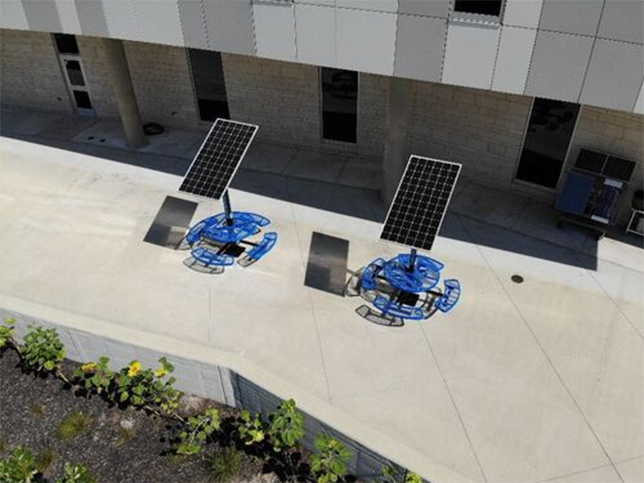
Over the summer, Olathe West High School added solar panels over two picnic tables where students can charge their phones and laptops.  

The solar arrays were installed by MC Power in front of the Kansas school. Each table has eight USB chargers powered by a large solar panel.

Each table has eight USB chargers powered by a large solar panel.

“The kids think it’s pretty cool to charge their devices with the sun,” Cody Janousek, Green Tech Academy facilitator, said to a local newspaper. “There are no wires coming out of the school to the charging stations, so it’s a bit of scientific magic to make it happen. Our phones don’t really use all that much energy, so I emphasize how cool it is to have the phones powered directly by the sun.”

The high school is one of the most sustainable high school buildings in the nation, according to their website. It’s already outfitted with enough solar panels to make their footprint net-zero in energy consumption, Janousek said.

The solar panels are outside of the Green Tech Academy, one of the 15 different 21st Century Academies available at Olathe Public Schools. The Green Tech program is hosted at the high school and teaches students about renewable energy and sustainability.

About the Author

Yvonne Marquez is senior editor of Spaces4Learning. She can be reached at [email protected].

Featured

  • Porter Family Center

    Porter Family Center for Innovation and Academics

    Established in 1999, the Education Design Showcase is a vehicle for showing off innovative — yet practical — solutions in planning, design, architecture, and construction. The Porter Family Center for Innovation and Academics has been recognized with an EDS 2026 Project of Distinction award in the category of New Construction.

  • Designing for Every Mind

    Learning environments have the power to shape not just what students know, but who they become. When a school is designed with genuine empathy—for the full range of ways students think, sense, and engage with the world—it becomes more than a building. It becomes a catalyst for growth, confidence, and belonging. That is the animating idea behind neurodiverse design, and it is one that is transforming how more architects and designers are thinking about school design.

  • Indiana University Launches Capital Campus in D.C.

    Indiana University recently held a ribbon-cutting ceremony for the new IU Capital Campus in Washington, D.C., according to university news. The eight-story facility will provide a central hub for the university’s existing programs and business operations based in D.C., uniting them under one roof and providing the opportunity to expand.

  • Cleveland High School Breaks Ground on Modernization

    Portland Public Schools in Portland, Ore., recently announced that construction has begun on a modernization project for Cleveland High School, according to a news release. The existing building will be replaced with a new, 300,000-square-foot facility at the same site.