Lab Design: Keeping People in Mind
A people-centered focus of the design of lab spaces can encourage engagement and place more emphasis on the purpose of the lab, leading to success for the institution.
- By Tad Costerison
- 11/06/19
In 2017, the Nobel Prize in Chemistry was awarded to Jacques Dubochet, Joachim Frank, and Richard Henderson for the development of cryogenic-transmission electron microscopy (cryo-TEM), which simplifies and improves the imaging of the inner workings of the cell. Researchers can now freeze biomolecules mid-movement and visualize processes they have never previously seen, which is important for both the basic understanding of life's chemistry and for the development of pharmaceuticals.
For universities to attract the best and brightest scientists and researchers in the field, it is critical that they possess this breakthrough technology. But it is often a challenge to accommodate these massive pieces of equipment, whose dimensions can range from the size and weight of a large cow to those of a small recreational vehicle.
The minimum technical standards that must be met include critical factors such as vibration control, electromagnetic interference (EMI), vertical and horizontal clearances, liquid nitrogen (LN2) supply, chilled process water delivery, seismic anchoring, and an appropriate fire protection sprinkler system, in addition to effective room layout and finishes.
Too often, however, the imposing physical presence of the equipment, and the technical requirements that accompany it, will completely dictate the design process. This can be detrimental to the laboratory’s mission if the design fails to take into account the needs and preferences of the people using it. Instead, designers of cryo-TEM labs should strive to create an environment that encourages the highest degree of experimentation, collaboration, and exploration.
Thus, the true challenge in designing a cryo-TEM lab—or any space where scientific discovery is the goal —lies in the ability to elevate the experience for the people that work in the space and to help increase the value that their work brings to the campus. This can best be achieved by upholding the ideals of the human-centered design approach, even when the “star” in the room is a massive microscope.
Good Design Focuses on People
Designers of a cryo-TEM microscopy lab must remember that their work exists at the intersection of spatial experience and scientific experimentation. For this reason, it is imperative to solicit clear, honest, and complete input from the researchers who will be using the lab. Designers must talk with researchers about their daily process and workflow to gain a full understanding of how they use and move through the space. This helps to identify opportunities to improve efficiencies, which in turn enhances the researchers’ experience.
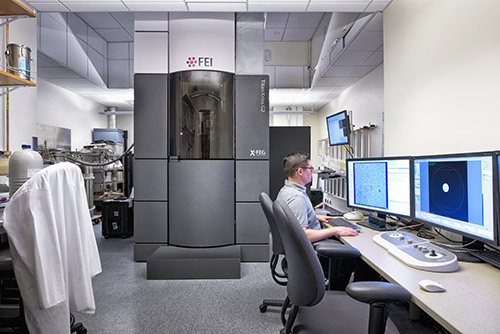
Photo © John Sutton Photography
To get the most research value from a cryo-TEM microscope, lab designers need to use a human-centered approach to drive collaboration and creativity.
The results of this inquiry can be astounding. In addition to providing information about space and environmental conditions and requirements, scientists can enlighten the design team with tales of how the microscopes work, what the equipment achieves, and how this technology contributes to the research being conducted. This collaborative analysis helps to stimulate the creative process, leading to a design that converts the abstract concepts expressed during the process into a physical design that frequently leaves the researchers equally amazed and impressed.
The team can augment verbal feedback with ethnographic research, a qualitative method used to observe and interact with researchers in their actual environment. Being literally “in the room” informs even higher levels of empathy and human-centered design ideas.
Integrating Cryo-TEM Microscopy Into the Institution
In one example from Taylor Design’s experience, a Cryo-TEM Microscopy lab located on a University of California campus was initially an unintentional well-kept secret. All the work being done was behind closed doors, and the lab was the exclusive domain of the researchers that worked there.
Socialization in laboratories is one way to stimulate researcher engagement, retention, and overall levels of inspiration. To that end, the lab team expressed a clear desire for increased transparency, leading to the design decision to place flat-panel display monitors in the hallway outside the lab. By putting “science on display,” this simple act promoted the concept of transparency in science, which in turn led to faster and better professional connections and exchanges of ideas.
The monitors, in this example, are an installation to engage more people, and to socialize what is happening in the lab. More and more laboratory designs include interactive installations to encourage this kind engagement and interaction. This is the part of the all-important design strategy, which successfully sought to connect people in new and exciting ways, fostering the unexpected encounters that lead to new ideas and innovations.
The institution’s business model is another consideration that goes well beyond the borders of the lab. For example, if the microscope is a shared instrument, available for rent, there is suddenly a retail element to consider. In this case, the designer must ensure that the facility can accommodate multiple constituencies, none of whom actually “owns” the space. This broadens the focus of the user interviews into areas such as the room reservation process, data storage, and security.
This also speaks to the need to avoid designing a laboratory too generically. Clear articulation of purpose in campus laboratory design reinforces the institution’s vision and strategy. And since most experimentation today is multimodal, with no set place or single user, the people-centered focus of the design can encourage engagement and place more emphasis on the purpose of the lab.
When all else is stripped away, the ultimate task of the cryo-TEM lab designer is to help improve the researcher’s outcome through proper physical placemaking. By focusing on the human experience, while also partnering with highly regarded scientists, research institutions, and technologists to accelerate discovery, designers can play a pivotal role in increasing the impact that this new technology can have on society, the school, and the scientific community.
About the Author
Tad Costerison, AIA, LEED-AP, NCARB, is an architect and project leader at Taylor Design, a strategy-based design firm with offices across California. Tad designs human-centered projects with an emphasis on user involvement, sustainable design strategies, and technically challenging solutions. He holds a Bachelor of Architecture and Environmental Design from Ball State University, is a licensed architect in California and Illinois, and sits on the board for the International Institute for Sustainable Laboratories.