Florida Tech to Build $18M Health Sciences Research Center

MELBOURNE, FL – Florida Institute of Technology will break ground in spring 2020 on a 61,000-square-foot Health Sciences Research Center that will help fill the growing demand for jobs in the biomedical and premedical science fields and allow students and faculty to conduct critical research in labs equipped with the latest cutting-edge technologies, from virtual-dissection tables to atomic force microscopes.

The new, $18 million facility will double the size of Florida Tech’s undergraduate biomedical engineering program to 300 full-time, on-campus students; increase the size of the undergraduate premedical program from 150 to 250 students; provide over 20,000 square feet of classroom and training spaces; and allow students access to teaching laboratories that use augmented and virtual reality tools and space for orthopedics, tissue studies and advanced computational simulations.
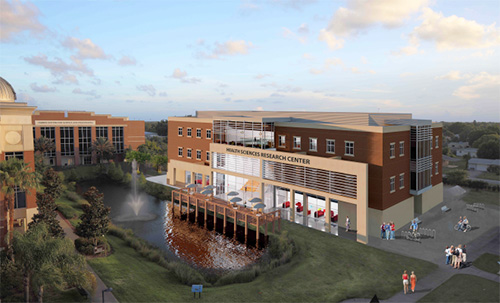
Florida Tech Health Sciences Center 500

The Center will be built on a vacant parcel of land on the south campus area known as the Olin Quad. It will be south of the Olin Life Sciences Building and adjacent to the quad’s newest buildings, the Harris Center for Assured Information, which opened in 2009.

The Center will be funded by the sale of Educational Facilities Revenue Bonds.

Featured

  • Benson Polytechnic High School in Portland, OR

    Preserving Legacy, Designing for the Future

    As historic academic buildings age, institutions face a difficult decision: preserve and adapt or demolish and rebuild. How do we honor the legacy of these spaces while adapting them to meet the needs of modern learners?

  • New Arizona Fine Arts School Reaches Construction Milestone

    Construction of the new Hilltop School for the Arts and Theater in Litchfield Park, Ariz., recently hit a significant milestone, according to a news release. The Agua Fria High School District held a beam-signing ceremony to celebrate the building’s topping out, or the placement of its last structural beam.

  • A digital silhouette works at a computer, immersed in a glowing, interconnected world

    How Will AI Transform Learning Space Design?

    For years, higher education has designed learning spaces around technology as a tool for display, capture, collaboration, and connectivity. AI changes that equation.

  • abstract illustration of school gym

    How the Gymnasium Can Serve as a Model for Learning Space Design

    Multipurpose gyms work because flexibility was built into the brief from the start, not retrofitted later. The same logic applies to academic spaces.