University of Arkansas Civil Engineering Research Center Breaks Ground

FAYETTEVILLE, AR –Leaders from across Arkansas gathered in early November to celebrate the groundbreaking of the University of Arkansas’ Civil Engineering Research and Education Center at the Arkansas Research and Technology Park. Known as CEREC, the 37,400-square-foot, $13.8-million facility will serve as a research and teaching space for the Department of Civil Engineering and will be a resource for academic, government, and industrial partners across Arkansas.
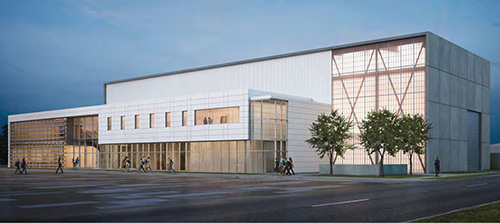
UArkansas Civil Engineering 500

The space includes a high-bay structural testing facility with a four-foot thick “strong-floor” capable of testing large-scale structural systems and components. It will also house a 25-ton rail crane to move heavy materials.

The facility will be the first of its kind in Arkansas. Currently, large-scale structural components must be sent out of state for testing. CEREC will allow academic, industry, and government researchers to conduct cutting-edge experimental research in-state.CEREC will also serve as a living laboratory for several hundred students annually, and the facility has space for 15 faculty members to conduct research.

The project is expected to be complete in spring 2021, with the first classes set to start in the fall of that year.

Featured

  • Moline-Coal Valley School District to Consolidate Two Schools into New Facility

    The Moline-Coal Valley School District in Moline, Ill., recently broke ground on a new elementary school that will consolidate the students and staff from two existing schools, according to local news. Robert Ontiveros Elementary School will serve as the new home for Lincoln-Irving Elementary School and Willard Elementary School.

  • Can AI Help Build Stronger Communities in Student Housing?

    Student housing success is shifting from operational performance to student experience, with belonging now at the center. A recent 2025 report underscores a growing emphasis on student well-being, community, and engagement, signaling that expectations now extend beyond logistics to ensure students feel supported in their living environments. AI is enabling that shift by reducing administrative workload and giving teams more time to focus on meaningful student engagement.

  • Pitzer College

    Designing for Change in Higher Ed Learning Environments

    Higher education will continue to evolve, and learning environments must evolve with it. By prioritizing adaptable infrastructure, thoughtful reuse, strong energy performance, and wellness-centered design, campuses can create spaces that support learning today while remaining flexible for the future.

  • Cal Poly Humboldt Starts Construction on Healthcare Education Hub

    California State Polytechnic University, Humboldt in Arcata, Calif., recently announced that work has begun on a renovation project that will turn the Stewart Building into a new Healthcare Education Hub, according to a news release. The university is partnering with Sundt Construction Inc. for construction services.