Student Housing Project Completed at Cal Poly Pomona

POMONA, CA – Phase 1 of the first-year student housing replacement project at California State Polytechnic University, Pomona, was recently completed.

“This project was truly a team effort,” says Sundt Construction Vice President Robert Stokes. “Together with university staff, and our design-build partners, we were able to present Cal Poly with the transformative project they were looking for.”
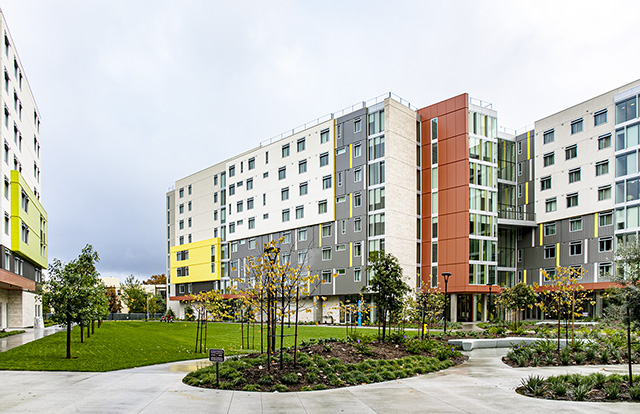
Cal Poly Pomona Housing

Photo courtesy of Sundt Construction

The project consists of two eight-story towers that house 980 students and includes a 35,000-square-foot dining facility. Both towers are structural concrete constructed by Sundt’s own concrete crews. The project included the relocation of approximately 2,600 linear feet of Kellogg Drive, and the addition of 400 parking spaces around the area.

The mid-rise design includes shared social spaces, welcomes in natural light, and makes open-air connections throughout the entire eight floors of each of the two new buildings. Large windows allow insight to the social activities happening inside. Each floor has two 35-student households, which promote social engagement with living rooms, shared bathrooms that support gender equality and large communal stairway lounges. Bedrooms feature abundant natural light while hallways end in views toward the campus and local mountains. Shared social spaces create an intimate environment where students can interact and make life-long connections.

With the site being 16 acres, and the project itself being a little more than 10 acres, it was the largest project to date for the university.

The project was also the first collaborative design-build project for Cal Poly Pomona. Sundt Construction teamed up with HMC Architects and EYRC Architects to complete the $162-million project.

Featured

  • Q&A: How to Prevent Kitchen Grease Fires in Commercial Kitchens

    School cafeterias and university dining halls serve thousands of meals daily, relying on high-heat equipment like fryers, grills, and ovens. While these operations keep students fed, they also generate significant grease-laden vapors. Without proper controls, this grease becomes a silent fire threat. As a certified exhaust cleaning specialist and business coach who has helped hundreds of institutional facilities achieve NFPA 96 compliance, I emphasize that proactive grease management isn’t optional; it’s a core fire/life safety practice.

  • Texas A&M Opens First Building at Fort Worth Campus, Breaks Ground on Research Facility

    The Texas A&M University System marked a major milestone in the development of its Fort Worth campus by opening its first completed academic building and breaking ground on a second facility designed to expand research and industry collaboration.

  • Planning with Clarity: Using AI to Make Better Campus Decisions, Not Just Better Designs

    Higher education leaders are being asked to make increasingly high-stakes decisions about campus facilities amid greater uncertainty than ever before. Social and economic pressures, shifting enrollment, and evolving learning models compete with growing deferred maintenance needs to strain even the most robust infrastructure budgets.

  • CU-Lock Haven Receives $1.75M Gift for New Entrepreneurship, Media Center

    Commonwealth University-Lock Haven in Lock Haven, Penn., recently received a $1.75-million donation from entrepreneur and alumnus Nicholas Subich ’17, according to a university news release. The funds will go toward establishing the Nicholas Subich Center for Entrepreneurship and Media, a technology-driven hub for innovation and experiential learning.