"Welcome Center" Automates Health, Mask Check-in

A company that produces technology for the food industry has developed a "welcome center" that schools can use to automate student and staff check-in. The "AI Welcome Center" from PreciTaste uses artificial intelligence and computer "vision" to guide users through a touch-free check-in experience.
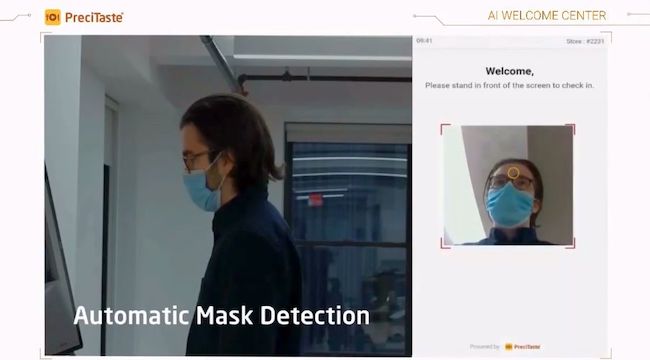
AI Welcome Center automatically turns on when a person faces it. Then it performs a quick temperature measure with laser-sensing technology and checks for face masks using "vision AI."

The system automatically turns on when a person faces it. Then it performs a quick temperature measure with laser-sensing technology and checks for face masks using "vision AI."

Students can have IDs scanned, and visitors can receive printed labels identifying that they have been scanned. According to the company, the check-in process takes under 15 seconds and the program retains no personally identifiable information. However, a contract tracing feature lets students opt-in to receive alerts in the event of a positive case, to assist the school in doing contact tracing.

The program provides for a voice-activated questionnaire to customize the set-up for a given state's regulations and recommendations.

A module for occupancy management is also available as an add-on feature.

About the Author

Dian Schaffhauser is a former senior contributing editor for 1105 Media's education publications THE Journal, Campus Technology and Spaces4Learning.

Featured

  • University of Tennessee at Chattanooga Launches New Emergency Communications System

    The University of Tennessee at Chattanooga (UTC) recently deployed a new emergency notification and incident management system for its campus, according to a news release. The university partnered with 911Cellular to launch Safe@UTC, a smartphone app allowing university officials to communicate and respond during emergency situations.

  • Spaces4Learning Trends & Predictions for Educational Facilities in 2026: Part II

    As education leaders look toward 2026, the design of K–12 and higher education facilities is being reshaped by powerful, converging forces. Survey respondents point to the rapid growth of Career and Technical Education, deeper alignment with workforce and industry needs, and the accelerating influence of AI and emerging technologies.

  • University of Arizona Approves New Residence Hall

    The Arizona Board of Regents recently approved plans for a new residence hall at the University of Arizona in Tucson, Ariz., according to a news release. The new facility is scheduled to open in fall 2028 and have the capacity for more than 1,200 students, enforcing a new university expectation that all first-year students live on campus.

  • How a Portable Sink Helped an Art Classroom Run More Smoothly

    Classroom design decisions can have outsized effects on instructional time and safety at schools juggling mismatched infrastructure, strict budgets, and crowded schedules — particularly in the arts. Between spilled paint and dirty brushes, art classes run smoother with a sink in the studio. But many schools don’t have a sink in every art classroom.