VS America to Discuss How Physical Spaces Impact Student Well-Being

VS America, a full-service manufacturer of school and office furniture, will host a webinar on Friday, March 19, discussing the opportunities and obstacles facing students as they return to school. The conversation will feature four panelists and focus on the impact of physical learning spaces on students’ mental and emotional well-being.

A survey of high-school students conducted by America’s Promise Alliance has revealed the various negative effects of COVID-19 in areas like social connection, emotional health, and learning time. Results show that 29% of students surveyed don’t feel connected to others, while 25% have difficulty sleeping due to negative emotions and 38% are concerned about their present and future education opportunities. The return to in-person learning, in other words, will entail much more than just catching up on the finer points of trigonometry.
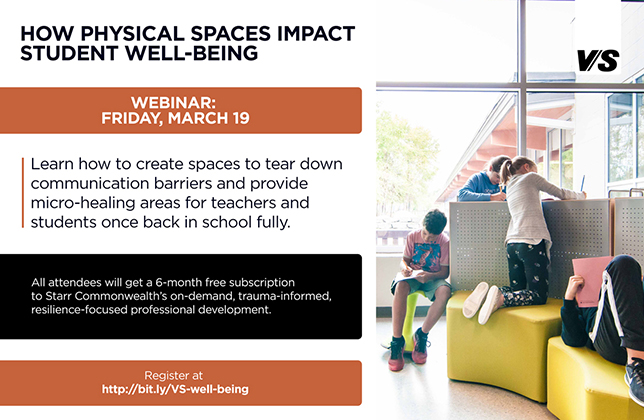
Student well-being webinar

The webinar’s panelists include:

  • Dr. RJ Webber, Assistant Superintendent of Curriculum and Instruction at Novi Community Schools in Novi, Mich.
  • Dr. Caelan Soma, Chief Clinical Officer and Senior Trainer at Starr Commonwealth
  • Jill Ackers, Learning Designer at Fielding International
  • Roger B. Fisher, Associate Director of the Program on Intergroup Relations (IGR) at the University of Michigan

According to a press release, the webinar is slated to cover “how schools can create spaces to allow for the healing and connectivity needed.”

You can register here to attend. Attendees will also receive a free 6-month subscription to Starr Commonwealth’s “on-demand, trauma-informed, resilience-focused professional development.” The event will take place from 12:00–1:30 p.m. Eastern Time (9:00–10:30 a.m. Pacific Time) on Friday, March 19.

About the Author

Matt Jones is senior editor of Spaces4Learning. He can be reached at [email protected].

Featured

  • Architectural Power for the Modern Campus Landscape

    For generations, an outdoor classroom only required a textbook and a patch of grass. Today, not only has the laptop replaced the printed pages, the rise of agile learning has turned campuses into study halls with students listening to lectures and researching topics from quads, gardens, and plazas. The challenge for architects and facility managers is to provide connectivity without cluttering the landscape with visual eyesores or creating safety hazards with extension cords.

  • Colorado School District Breaks Ground on Unified PK–12 Campus

    The Haxtun School District No. Re-2J in Haxtun, Colo., recently announced that ground has been broken on a renovation/addition project that will unite its two schools, Haxtun Elementary and Haxtun Jr/Sr High School, according to a news release.

  • Q&A: How to Prevent Kitchen Grease Fires in Commercial Kitchens

    School cafeterias and university dining halls serve thousands of meals daily, relying on high-heat equipment like fryers, grills, and ovens. While these operations keep students fed, they also generate significant grease-laden vapors. Without proper controls, this grease becomes a silent fire threat. As a certified exhaust cleaning specialist and business coach who has helped hundreds of institutional facilities achieve NFPA 96 compliance, I emphasize that proactive grease management isn’t optional; it’s a core fire/life safety practice.

  • Montclair State University Starts Construction on $120M STEM Building

    Montclair State University in Montclair, N.J., recently broke ground on a new $120-million Interdisciplinary Science Building, according to university news. The university partnered with HoK Architects for the project’s design, and it’s scheduled to open in time for the 2028–29 academic year.