San Diego Unified School District Breaks Ground on Two Modernization Projects
The San Diego Unified School District has officially begun modernization projects on two of its schools: La Jolla Elementary School and John Muir Language Academy. California builders C.W. Driver Companies broke ground on both construction projects last week. Work on both schools will entail renovations of existing buildings as well as the construction of new ones. The architects of record for the project are domusstudio architecture for La Jolla and the Baker Nowicki Design Studio for John Muir.
The work at La Jolla Elementary School (K-5) is scheduled to include upgrading existing permanent buildings and constructing a new two-story classroom and administrative building, a new kindergarten classroom building, a new lunch facility, and a restroom building for the school’s upper athletic field. Modernization of the existing structures includes infrastructure and technology updates, a maker space, outdoor learning areas, and a larger parking lot. An existing kitchen will also be remodeled, and the existing campus administration building will house more classrooms.
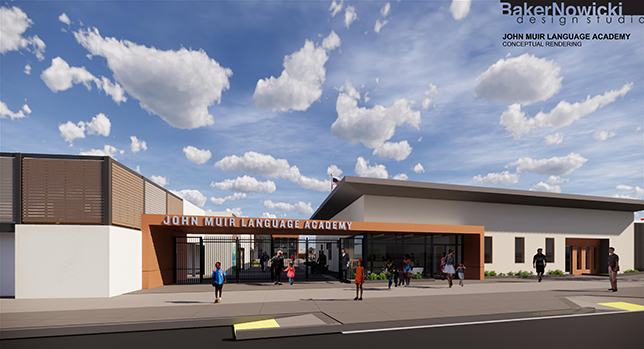
Photo Credit: domusstudio architecture
At the John Muir Language Academy (K-8), workers will add a new two-story PE locker room and classroom building and a new administration building, as well as expansions of the kindergarten and kitchen facilities. All existing permanent buildings will also be updated.
“C.W. Driver Companies is proud to partner with San Diego Unified School District on the continued updating of its schools throughout the county,” said Keith Kauffman, Project Executive with C.W. Driver Companies. “We will leverage our extensive experience in building education facilities to deliver an engaging, collaborative environment while minimizing the impact of construction on students, faculty and staff.”
The construction at the John Muir Language Academy is expected to last until 2023, while work at La Jolla Elementary School is slated for completion in 2024.
“As the second-largest district in California serving more than 121,000 students in preschool through Grade 12, providing optimized learning environments for our students is a top priority,” said the Chief Facilities Planning and Construction Officer with the San Diego Unified School District, Lee Dulgeroff. “We are confident that C.W. Driver Companies’ modernizations of La Jolla Elementary and John Muir Language Academy will enhance the educational experience and prepare our students for the future.”
About the Author
Matt Jones is senior editor of Spaces4Learning. He can be reached at [email protected].