Energy Harness Releases Ceiling-Mounted UV-C Light Fixture

LED manufacturing and distribution solutions provider Energy Harness recently released a new product to help schools combat COVID-19. The Active Airflow UV-C fixture is a “germicidal” light fixture that sucks in air and treats it with ultraviolet light, providing an enclosed space with continuous disinfection from the virus as well as other airborne bacteria and germs.

The enclosed device can be installed in ceiling grids to treat indoor areas of up to 256 square feet. It can connect to the ceiling’s existing power grid used to power light fixtures. Multiple units can be installed in larger rooms to offer the same treatment. The unit does not produce visible light.
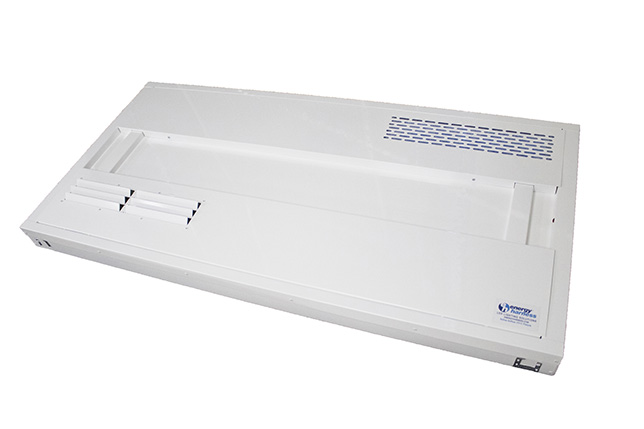
Energy Harness Active Airflow

Nationally recognized testing lab Intertek Laboratories found that the Active Airflow UV-C has a 99.9% effectiveness rate in eliminating pathogens from the air. Testing on the SARS-CoV-2 virus revealed that the device has a 99.998% inactivation rate for that virus in particular within a single second.

“We have demonstrated and studies have shown the effectiveness of UV-C light in killing the COVID-2 family of pathogens,” said the managing director of Energy Harness’ Midwest division, Patricio M. Daneri. “Our Active Airflow unit provides the added advantage of safe usage during the school day in occupied classrooms. The unit has a fan system to draw in the air, where it is cleaned and then cycled back into the room.”

About the Author

Matt Jones is senior editor of Spaces4Learning. He can be reached at [email protected].

Featured

  • Nashville Elementary School Receives LEED Gold Certification

    Goodlettsville Elementary School, part of Metro Nashville Public Schools in Nashville, Tenn., recently achieved LEED Gold Certification from the U.S. Green Building Council (USGBC), according to a news release. The 81,750-square-foot school opened in 2023 and was designed by Goodwyn Mills Cawood (GMC).

  • Building Beyond Simulation: Creating Immersive Ecosystems for Healthcare Education

    Health sciences education is one of the fastest-growing facility types in colleges and universities. The demand for medical, nursing, and allied health professionals is driving the creation and renovation of medical simulation training facilities that provide students with real-world experience through advanced simulation-based learning.

  • Planning with Clarity: Using AI to Make Better Campus Decisions, Not Just Better Designs

    Higher education leaders are being asked to make increasingly high-stakes decisions about campus facilities amid greater uncertainty than ever before. Social and economic pressures, shifting enrollment, and evolving learning models compete with growing deferred maintenance needs to strain even the most robust infrastructure budgets.

  • University of Pennsylvania Releases Design of Future Physical Sciences Building

    The University of Pennsylvania (Penn) in Philadelphia, Penn., recently released renderings of an upcoming 350,000-square-foot Physical Sciences Building, according to news release. The facility was designed by CO Architects and will unite the university’s departments of Physics and Astronomy, Mathematics, and Earth and Environmental Science.